
SEBA Class 10 Maths Exercise 12.1 Solutions: Surface Areas and Volumes | New Book 2026
Get free, reliable solutions to SEBA Class 10 Maths Exercise 12.1: Surface Areas and Volumes from the new 2026 SCERT textbook. In this article, we solve all textbook questions—from Question 1 to 14—in a simple way.
If you are a student of Class 10 under the SEBA/Assam Board preparing for your upcoming HSLC examinations, these reliable and easy-to-understand solutions with a 3D image of every question will help you understand every question of Exercise 12.1: Surface Areas and Volumes.
See More:
- SEBA Class 10 Maths Exercise 10.1 Solutions: Circles
- SEBA Class 10 Maths Exercise 10.2 Solutions: Circles
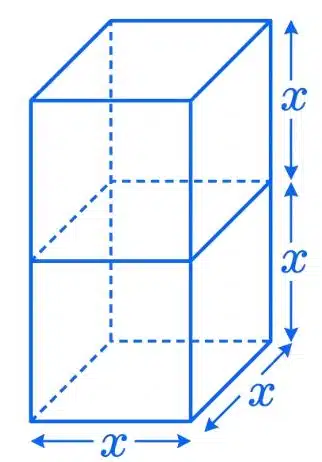
1. $2$ cubes each of volume $64\text{ cm}^3$ are joined end to end. Find the surface area of the resulting cuboid.
$\mathbf{Sol^n.}$
Let the length of each edge of the cube be $x\text{ cm}$.
Therefore, volume of the cube $= {x}^3$
Given, volume of each cube $= 64\text{ cm}^3$
$\implies x^3 = 64$
$\implies x = \sqrt[3]{64} = \sqrt[3]{4^3}$
∴ $ x = 4\text{ cm}$
When two cubes of equal volume are joined end to end, a cuboid is formed. The dimensions of the resulting cuboid are:
- Length $l$ $= x\text{ cm} = 4\text{ cm}$
- Breadth $b$ $= x\text{ cm} = 4\text{ cm}$
- Height $h$ $= (x + x)\text{ cm} = (4 + 4)\text{ cm} = 8\text{ cm}$
Now, $\text{Surface area of the resulting cuboid} = 2(lb + bh + hl)$
$= 2(4 \times 4 + 4 \times 8 + 8 \times 4)\text{ cm}^2$
$= 2(16 + 32 + 32)\text{ cm}^2$
$= 2 \times 80\text{ cm}^2$
$= 160\text{ cm}^2$
$\therefore$ The required surface area of the resulting cuboid is $160\text{ cm}^2$
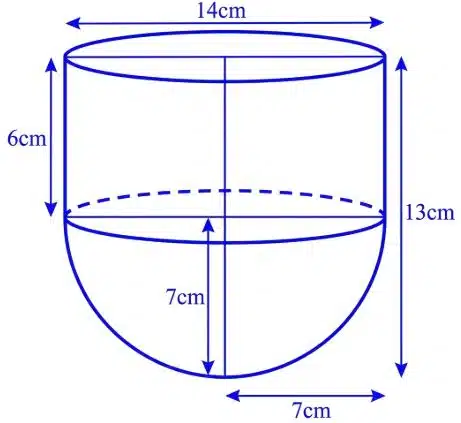
2. A vessel is in the form of a hollow hemisphere mounted by a hollow cylinder. The diameter of the hemisphere is $14\text{ cm}$ and the total height of the vessel is $13\text{ cm}$ . Find the inner surface area of the vessel.
$\mathbf{Sol^n.}$ Given:
- Diameter of the hemisphere $= 14\text{ cm}$
- Radius of the hemisphere ($r$) $= \frac{14}{2} = 7\text{ cm}$
- Radius of the base of the cylinder ($r$) $= 7\text{ cm}$
- Total height of the vessel $= 13\text{ cm}$
Now, $\text{Height of the cylinder } (h) $
$ = \text{Total height of the vessel} – \text{Radius of the hemisphere}$
$= 13\text{ cm} – 7\text{ cm}$
$= 6\text{ cm}$
Therefore, $\text{Inner surface area of the vessel} $
$ = \text{CSA of the hemisphere} + \text{CSA of the cylinder}$
$= 2\pi r^2 + 2\pi rh$
$= 2\pi r(r + h)$
$= 2 \times \frac{22}{7} \times 7 \times (7 + 6)\text{ cm}^2$
$= 2 \times 22 \times 13\text{ cm}^2$
$= 572\text{ cm}^2$
$\therefore$ The required inner surface area of the vessel is $572\text{ cm}^2$.
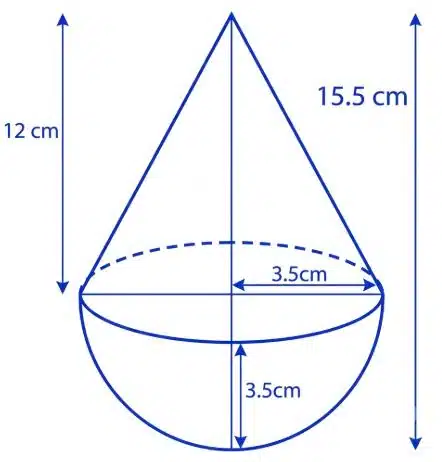
3. A toy is in the form of a cone of radius $3.5\text{ cm}$ mounted on a hemisphere of same radius. The total height of the toy is $15.5\text{ cm}$ . Find the total surface area of the toy.
$\mathbf{Sol^n.}$ Given:
- Radius of the conical part ($r$) $= 3.5\text{ cm}$
- Radius of the hemispherical part ($r$) $= 3.5\text{ cm}$
- Total height of the toy $= 15.5\text{ cm}$
Now, $\text{Height of the conical part } (h) $
$ = \text{Total height of the toy} – \text{Radius of the hemispherical part}$
$= 15.5\text{ cm} – 3.5\text{ cm}$
$= 12\text{ cm}$
Let $l$ be the slant height of the conical part:
∴ $l = \sqrt{r^2 + h^2}$
$\implies l = \sqrt{(3.5)^2 + (12)^2}\text{ cm}$
$\implies l = \sqrt{12.25 + 144}\text{ cm}$
$\implies l = \sqrt{156.25}\text{ cm}$
$\implies l = 12.5\text{ cm}$
Now, $\text{Total surface area of the toy}$
$ = \text{CSA of the conical part} + \text{CSA of the hemispherical part}$
$= \pi rl + 2\pi r^2$
$= \pi r(l + 2r)$
$= \frac{22}{7} \times 3.5 \times (12.5 + 2 \times 3.5)\text{ cm}^2$
$= \frac{22}{7} \times 3.5 \times (12.5 + 7.0)\text{ cm}^2$
$= 22 \times 0.5 \times 19.5\text{ cm}^2$
$= 11 \times 19.5\text{ cm}^2$
$= 214.5\text{ cm}^2$
$\therefore$ The required total surface area (TSA) of the toy is $214.5\text{ cm}^2$.
4. A cubical block of side $7\text{ cm}$ is surmounted by a hemisphere. What is the greatest diameter the hemisphere can have? Find the surface area of the solid.
$\mathbf{Sol^n.}$
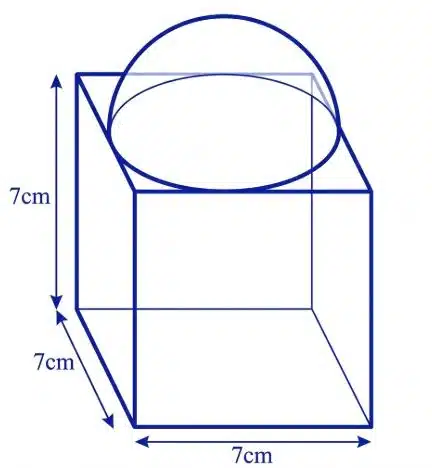
Given, length of the side of the cubical block ($l$) $= 7\text{ cm}$
The greatest diameter the hemisphere can have is equal to the length of the side of the cubical block, i.e., $7\text{ cm}$.
$\therefore \text{Diameter of the hemisphere } (d) = (l) = 7\text{ cm}$
$\therefore \text{Radius of the hemisphere } (r) = \frac{7}{2}\text{ cm}$
Now, $\text{Total surface area of the solid} $
$ = \text{Surface area of cubical part} + \text{CSA of hemispherical part} – \text{Area of base of hemispherical part}$
$= 6 l^2 + 2\pi r^2 – \pi r^2$
$= 6 l^2 + \pi r^2$
$= 6(7)^2 + \left(\frac{22}{7}\right)\left(\frac{7}{2}\right)^2\text{ cm}^2$
$= (6 \times 49) + \left(\frac{22}{7} \times \frac{49}{4}\right)\text{ cm}^2$
$= 294 + 38.5\text{ cm}^2$
$= 332.5\text{ cm}^2$
$\therefore$ The greatest diameter the hemisphere can have is $7\text{ cm}$ and the total surface area of the solid is $332.5\text{ cm}^2$.
5. A hemispherical depression is cut out from one face of a cubical wooden block such that the diameter $l$ of the hemisphere is equal to the edge of the cube. Determine the surface area of the remaining solid.
$\mathbf{Sol^n.}$
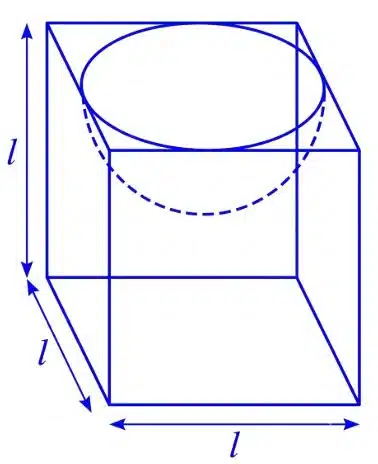
Given:
- Diameter of the hemisphere $=$ Edge of the cubical wooden block $= l\text{ units}$
- Radius ($r$) of the hemispherical part $= \frac{l}{2}\text{ units}$
Now, $\text{Total surface area of the remaining solid} =$
$ = \text{Total Surface area of cubical part} + \text{CSA of hemispherical part} – \text{Area of base of hemispherical part}$
$= 6(l)^2 + 2\pi r^2 – \pi r^2$
$= 6(l)^2 + \pi r^2$
$= 6(l)^2 + \pi\left(\frac{l}{2}\right)^2$
$= 6l^2 + \frac{\pi l^2}{4}$
$= \frac{24l^2 + \pi l^2}{4}$
$= \frac{1}{4}(24 + \pi)l^2\text{ square units}$
$\therefore$ The surface area of the remaining solid is $\frac{1}{4}(24 + \pi)l^2\text{ square units}$.
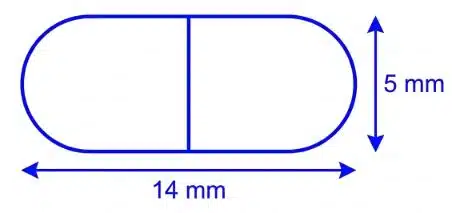
6. A medicine capsule is in the shape of a cylinder with two hemispheres stuck to each of its ends (see Fig. 12.10). The length of the entire capsule is $14\text{ mm}$ and the diameter of the capsule is $5\text{ mm}$ . Find its surface area.
$\mathbf{Sol^n.}$
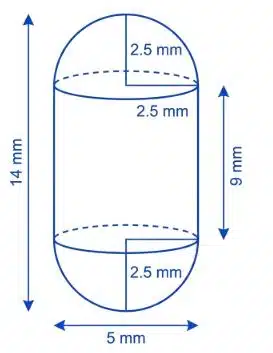
Given:
- Diameter of the capsule $= 5\text{ mm}$
- Radius of the cylindrical part ($r$) $= \frac{5}{2} = 2.5\text{ mm}$
- Radius of each hemispherical end ($r$) $ = 2.5\text{ mm}$
- Total length of the entire capsule $= 14\text{ mm}$
Now, $\text{Length of the cylindrical part } (h) $
$ = \text{Total length of the capsule} – 2 \times \text{Radius of a hemispherical end}$
$= 14 – 2\left(\frac{5}{2}\right)$
$= 14 – 5$
$= 9\text{ mm}$
Therefore, $\text{Surface area of the capsule} $
$ = \text{CSA of the cylindrical part} + 2 \times \text{CSA of a hemispherical end}$
$= 2\pi rh + 2(2\pi r^2)$
$= 2\pi r(h + 2r)$
$= 2 \times \frac{22}{7} \times \frac{5}{2} \times \left(9 + 2 \times \frac{5}{2}\right)\text{ mm}^2$
$= \frac{22}{7} \times 5 \times (9 + 5)\text{ mm}^2$
$= \frac{22}{7} \times 5 \times 14\text{ mm}^2$
$= 22 \times 5 \times 2\text{ mm}^2$
$= 220\text{ mm}^2$
$\therefore$ The required surface area of the medicine capsule is $220\text{ mm}^2$.
7. A tent is in the shape of a cylinder surmounted by a conical top. If the height and diameter of the cylindrical part are $2.1\text{ m}$ and $4\text{ m}$ respectively, and the slant height of the top is $2.8\text{ m}$ , find the area of the canvas used for making the tent. Also, find the cost of the canvas of the tent at the rate of $\text{Rs } 500\text{ per m}^2$ . (Note that the base of the tent will not be covered with canvas.)
$\mathbf{Sol^n.}$
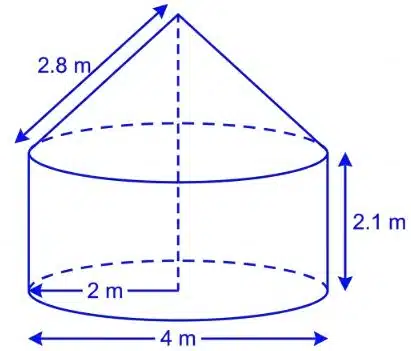
Given:
- Height of the cylindrical part ($h$) $= 2.1\text{ m}$
- Diameter of the cylindrical part $= 4\text{ m}$
- Radius of the base of the cylindrical part ($r$) $= \frac{4}{2} = 2\text{ m}$
- Radius of the base of the conical top ($r$) $= 2\text{ m}$
- Slant height of the conical top ($l$) $= 2.8\text{ m}$
Now, $\text{Area of the canvas used for making the tent} $
$ = \text{CSA of the cylindrical part} + \text{CSA of the conical top}$
$= 2\pi rh + \pi rl$
$= \pi r(2h + l)$
$= \frac{22}{7} \times 2 \times (2 \times 2.1 + 2.8)\text{ m}^2$
$= \frac{44}{7} \times (4.2 + 2.8)\text{ m}^2$
$= \frac{44}{7} \times 7\text{ m}^2$
$= 44\text{ m}^2$
Now,
Cost of $1\text{ m}^2$ canvas $= \text{Rs } 500$.
$\therefore \text{Total cost of } 44\text{ m}^2 \text{ canvas} = 44 \times \text{Rs } 500 = \text{Rs } 22000$
$\therefore$ The area of the canvas used for making the tent is $44\text{ m}^2$ and the total cost of the canvas is $\text{Rs } 22000$.
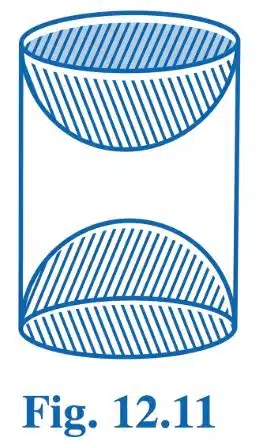
9. A wooden article was made by scooping out a hemisphere from each end of a solid cylinder, as shown in Fig. 12.11. If the height of the cylinder is $10\text{ cm}$ , and its base is of radius $3.5\text{ cm}$ , find the total surface area of the article.
$\mathbf{Sol^n.}$
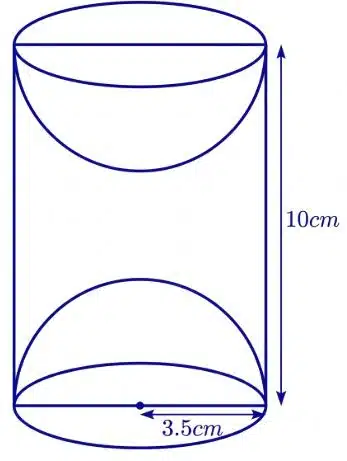
Given:
- Height of the cylinder ($h$) $= 10\text{ cm}$
- Radius of the base of the cylinder ($r$) $= 3.5\text{ cm}$
- Radius of each hemisphere scooped out ($r$) $= 3.5\text{ cm}$
Now, $\text{Total surface area of the article} $
$= \text{CSA of the cylinder} + 2 \times \text{CSA of a hemisphere scooped out}$
$= 2\pi rh + 2(2\pi r^2)$
$= 2\pi r(h + 2r)$
$= 2 \times \frac{22}{7} \times 3.5 \times (10 + 2 \times 3.5)\text{ cm}^2$
$= 2 \times 22 \times 0.5 \times (10 + 7)\text{ cm}^2$
$= 22 \times 17\text{ cm}^2$
$= 374\text{ cm}^2$
$\therefore$ The required total surface area of the article is $374\text{ cm}^2$.
10. A solid is hemispherical at the bottom and the top is conical. If the surface area of the two parts are equal, then ratio of its radius to the height of its conical part is.
(a) $1:\sqrt{2}$
(b) $\sqrt{2}:1$
(c) $1:\sqrt{3}$
(d) $\sqrt{3}:1$
$\mathbf{Sol^n.}$
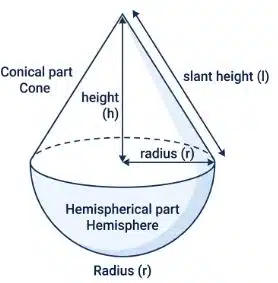
Let the radius of the hemispherical part and the conical part be $r$, and let the height and slant height of the conical part be $h$ and $l$ respectively.
Given,
$\text{Curved surface area of the hemispherical part} = \text{Curved surface area of the conical part}$
$\implies 2\pi r^2 = \pi rl$
$\implies 2r = l$
$\implies (2r)^2 = l^2$
$\implies 4r^2 = r^2 + h^2 \quad [\because l = \sqrt{r^2 + h^2} \implies l^2 = r^2 + h^2]$
$\implies 4r^2 – r^2 = h^2$
$\implies 3r^2 = h^2$
$\implies \frac{r^2}{h^2} = \frac{1}{3}$
$\implies \frac{r}{h} = \sqrt{\frac{1}{3}} = \frac{1}{\sqrt{3}}$
$\therefore r : h = 1 : \sqrt{3}$
Correct option is (c) $1:\sqrt{3}$
11. Two statements are given, one labelled as Assertion (A) and the other labelled as Reason (R)
Assertion (A): If a right circular cylinder of radius $r$ and height $h$ ($h > 2r$) just encloses a sphere, then the diameter of sphere is $2r$.
Reason (R): The surface area of the sphere is $2\pi r(r + h)$.
Choose the correct alternatives:
(a) Both Assertion (A) and Reason (R) are true and R is the correct explanation of Assertion (A)
(b) Both Assertion (A) and Reason (R) are true but R is not the correct explanation of Assertion (A).
(c) Assertion (A) is true but Reason (R) is false
(d) Assertion (A) is false but Reason (R) is true
$\mathbf{Sol^n.}$
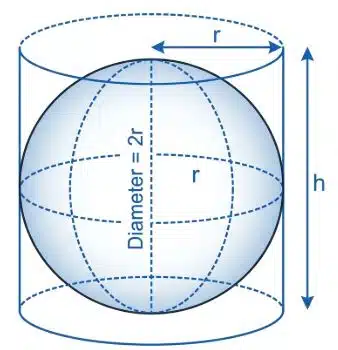
Checking Assertion (A): When a right circular cylinder of radius $r$ and height $h$ ($h > 2r$) just encloses a sphere, the sphere touches the curved walls of the cylinder, as shown in the figure above. So the radius of the sphere is equal to the radius of the cylinder ($r$).
Therefore, the diameter of the sphere is $2r$.
Hence, Assertion (A) is true.Checking Reason (R):
Surface area of a sphere $= 4\pi r^2$
Total surface area of a cylinder $= 2\pi r^2 + 2\pi rh = 2\pi r(r + h)$
Hence, Reason (R) is false.
Correct option is (c) Assertion (A) is true but Reason (R) is false
2. Match solids with their number of faces/curved surfaces:
| Column-I (Solids) | Column-II (Faces/Curved surface) |
| P) Sphere | i) Two flat + one curved face |
| Q) Cylinder | ii) Six flat surfaces |
| R) Cone | iii) One curved surface only |
| S) Cube | iv) One curved + one flat surface |
Select the correct option:
(a) $P \rightarrow (iii), Q \rightarrow (iv), R \rightarrow (i), S \rightarrow (ii)$
(b) $P \rightarrow (i), Q \rightarrow (ii), R \rightarrow (iii), S \rightarrow (iv)$
(c) $P \rightarrow (iii), Q \rightarrow (i), R \rightarrow (iv), S \rightarrow (ii)$
(d) $P \rightarrow (iii), Q \rightarrow (i), R \rightarrow (ii), S \rightarrow (iv)$
$\mathbf{Sol^n.}$
- P) Sphere: It is completely round and has only one curved surface and no flat face $\rightarrow \mathbf{(iii)}$
- Q) Cylinder: It has two flat circular ends (top and bottom) and one curved surface $\rightarrow \mathbf{(i)}$
- R) Cone: It has one curved surface and one flat circular base $\rightarrow \mathbf{(iv)}$
- S) Cube: It has six flat square faces $\rightarrow \mathbf{(ii)}$
Therefore, the matching sequence is $P \rightarrow (iii), Q \rightarrow (i), R \rightarrow (iv), S \rightarrow (ii)$.
Correct option is (c) $P \rightarrow (iii), Q \rightarrow (i), R \rightarrow (iv), S \rightarrow (ii)$
13. A toy is in the shape of a right circular cylinder with a hemisphere on one end and a cone on the other. The radius and height of the cylindrical parts are $5\text{ cm}$ and $13\text{ cm}$ respectively. The radii of the hemispherical and conical parts are the same as that of the cylindrical part. Find the surface area of the toy if the total height of the toy is $30\text{ cm}$.
$\mathbf{Sol^n.}$
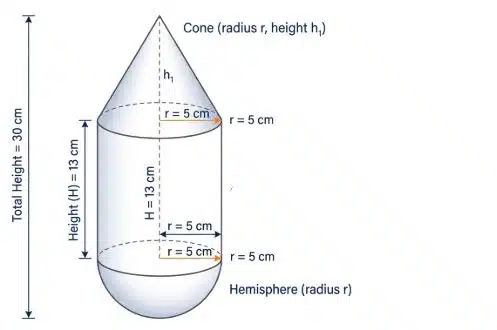
Given:
- Radius of the cylindrical part ($r$) $= 5\text{ cm}$
- Radius of the hemispherical part ($r$) $= 5\text{ cm}$
- Radius of the conical part ($r$) $= 5\text{ cm}$
- Height of the cylindrical part ($H$) $= 13\text{ cm}$
- Total height of the toy $= 30\text{ cm}$
Now,
$\text{Height of the conical part } (h)$
$= \text{Total height of the toy} – \text{Height of the cylindrical part} – \text{Radius of the hemispherical part}$
$= 30\text{ cm} – 13\text{ cm} – 5\text{ cm}$
$= 12\text{ cm}$
Let $l$ be the slant height of the conical part:
$\therefore l = \sqrt{r^2 + h^2}$
$\implies l = \sqrt{(5)^2 + (12)^2}\text{ cm}$
$\implies l = \sqrt{25 + 144}\text{ cm}$
$\implies l = \sqrt{169}\text{ cm}$
$\implies l = 13\text{ cm}$
Now,
$\text{Total surface area of the toy}$
$= \text{CSA of the hemispherical part} + \text{CSA of the cylindrical part} + \text{CSA of the conical part}$
$= 2\pi r^2 + 2\pi rH + \pi rl$
$= \pi r(2r + 2H + l)$
$= \frac{22}{7} \times 5 \times (2 \times 5 + 2 \times 13 + 13)\text{ cm}^2$
$= \frac{22}{7} \times 5 \times (10 + 26 + 13)\text{ cm}^2$
$= \frac{22}{7} \times 5 \times 49\text{ cm}^2$
$= 22 \times 5 \times 7\text{ cm}^2$
$= 770\text{ cm}^2$
$\therefore$ The required surface area of the toy is $770\text{ cm}^2$
14. A vessel in the form of a hollow hemisphere mounted by a hollow cylinder. The diameter of the hemisphere is $14\text{ cm}$ and the total height of the vessel is $13\text{ cm}$. Find the inner surface area of the vessel.
$\mathbf{Sol^n.}$
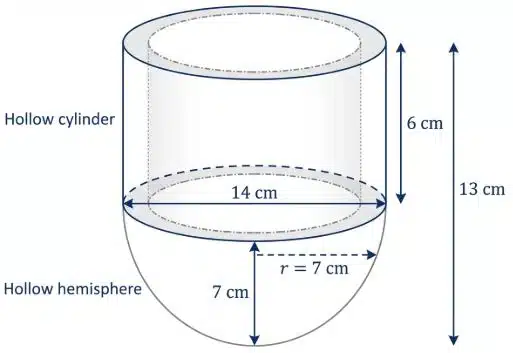
Given:
- Diameter of the hemisphere $= 14\text{ cm}$
- Radius of the hemisphere ($r$) $= \frac{14}{2} = 7\text{ cm}$
- Radius of the base of the cylinder ($r$) $= 7\text{ cm}$
- Total height of the vessel $= 13\text{ cm}$
Now, $\text{Height of the cylinder } (h)$
$= \text{Total height of the vessel} – \text{Radius of the hemisphere}$
$= 13\text{ cm} – 7\text{ cm}$
$= 6\text{ cm}$
Therefore, $\text{Inner surface area of the vessel}$
$= \text{CSA of the hemisphere} + \text{CSA of the cylinder}$
$= 2\pi r^2 + 2\pi rh$
$= 2\pi r(r + h)$
$= 2 \times \frac{22}{7} \times 7 \times (7 + 6)\text{ cm}^2$
$= 2 \times 22 \times 13\text{ cm}^2$
$= 572\text{ cm}^2$
$\therefore$ The required inner surface area of the vessel is $572\text{ cm}^2$.