
SEBA Class 10 Maths Chapter 10 Circles: Miscellaneous Solutions | New Book 2026
Get free, step-by-step solutions to SEBA Class 10 Maths Chapter 10: Circles Miscellaneous Questions from the new SCERT textbook 2026. In this article, we have solved all miscellaneous questions—from Question 118 to 136, including MCQs, Very Short Answer (VSA), Short Answer (SA), and Long Answer (LA) questions from this chapter 10: Circles—in a simple way.
If you are Class 10 students under the SEBA/Assam Board preparing for your upcoming HSLC examinations, these reliable, easy-to-understand solutions will help you master circle concepts, clear your doubts, and score full marks in your board exams.
See More
- SEBA Class 10 Maths Exercise 10.1 Solutions: Circles
- SEBA Class 10 Maths Chapter 10 Circles: Miscellaneous
- SEBA Class 10 Maths Chapter 9 Solutions: Some Applications of Trigonometry
Chapter 10 Circles: Miscellaneous Solutions: (MCQs)
118. $PQ$ is a tangent to a circle at $Q$. If the radius of the circle is $5\text{ cm}$, then the length of the tangent $PQ$ is:
(a) $5\sqrt{3}\text{ cm}$
(b) $10/\sqrt{3}\text{ cm}$
(c) $10\text{ cm}$
(d) $5/\sqrt{3}\text{ cm}$
$\mathbf{Sol^n.}$
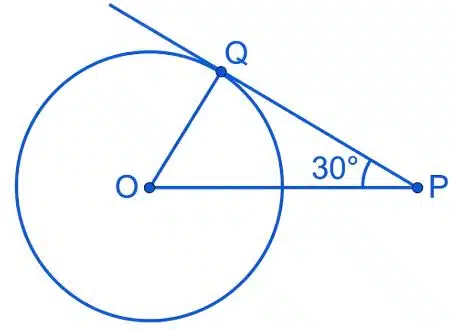
From the given figure,
$OQ = 5\text{ cm}$
$\angle OPQ = 30^\circ$.
Since the radius is perpendicular to the tangent,
∴$OQ \perp PQ \implies \angle OQP = 90^\circ$
In right-angled $\Delta OQP$, we have
$\tan 30^\circ = \frac{OQ}{PQ}$
$\implies \frac{1}{\sqrt{3}} = \frac{5}{PQ}$
$\implies PQ = 5\sqrt{3}\text{ cm}$
Correct option is (a) $5\sqrt{3}\text{ cm}$
119. In the given figure, $AC$ and $AB$ are tangents to a circle centered at $O$. If $\angle COD = 120^\circ$, then $\angle BAO$ is equal to:
(a) $30^\circ$
(b) $60^\circ$
(c) $45^\circ$
(d) $90^\circ$
$\mathbf{Sol^n.}$
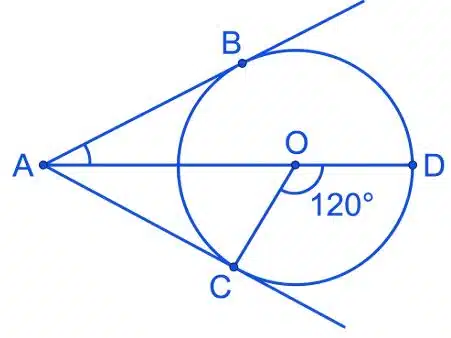
From the given figure,
$AOD$ is a straight line passing through the centre $O$, and
$\angle COD = 120^\circ$.
$\implies \angle AOC = 180^\circ – 120^\circ = 60^\circ$ [linear pair]
Since the radius is perpendicular to the tangent,
$\angle ACO = 90^\circ$
In right-angled $\Delta ACO$, we have
$\angle CAO + \angle ACO + \angle AOC = 180^\circ$ [Angle Sum Property of a triangle]
$\implies \angle CAO + 90^\circ + 60^\circ = 180^\circ$
$\implies \angle CAO = 180^\circ – 150^\circ $
$\implies \angle CAO = 30^\circ$
We know that two tangents drawn from an external point to a circle are equally inclined to the line segment joining the centre to that point:
$\therefore \angle BAO = \angle CAO = 30^\circ$
Correct option is (a) $30^\circ$
120. In the given figure, $AB$ is a tangent to the circle centered at $O$. If $OA = 6\text{ cm}$ and $\angle OAB = 30^\circ$, then the radius of the circle is:
(a) $3\text{ cm}$
(b) $3\sqrt{3}\text{ cm}$
(c) $2\text{ cm}$
(d) $\sqrt{3}\text{ cm}$
$\mathbf{Sol^n.}$
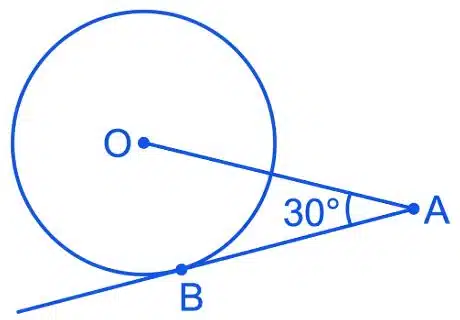
Given:
$OA = 6\text{ cm}$ and
$\angle OAB = 30^\circ$.
Since $AB$ is a tangent to the circle at $B$ and $OB$ is the radius:
$ \angle OBA = 90^\circ$
In right-angled $\Delta OBA$, we have
$\sin 30^\circ = \frac{OB}{OA}$
$\implies \frac{1}{2} = \frac{OB}{6}$
$\implies OB = \frac{6}{2} = 3\text{ cm}$
Therefore, the radius of the circle is $3\text{ cm}$.
Correct option is (a) $3\text{ cm}$
121. In the given figure, $AB = BC = 10\text{ cm}$. If $AC = 7\text{ cm}$, then the length of $BP$ is:
(a) $3.5\text{ cm}$
(b) $7\text{ cm}$
(c) $6.5\text{ cm}$
(d) $5\text{ cm}$
$\mathbf{Sol^n.}$
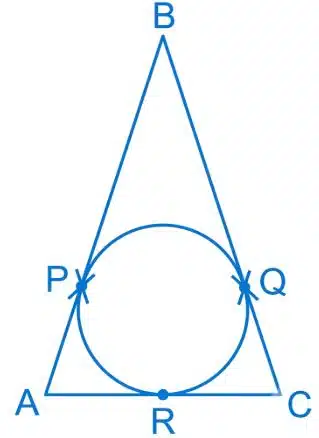
Given: $AB = BC = 10\text{ cm}$ and $AC = 7\text{ cm}$.
We know that the lengths of tangents drawn from an external point to a circle are equal.
Therefore:
- $AR = AP$
- $CR = CQ$
- $BP = BQ$
Since $AB = BC$
$AB – BP = BC – BQ $ [Since, $BP = BQ$]
$\implies AP = CQ$
$\implies AR = CR$
Since $AC = AR + CR = 7\text{ cm}$ a
$\implies 2AR = 7 $ [Since, $AR = CR$ ]
$\implies AR = \frac{7}{2} = 3.5\text{ cm}$
$\therefore AP = AR = 3.5\text{ cm}$
Now,
$BP = AB – AP$
$= 10 – 3.5$
$= 6.5\text{ cm}$
Correct option is (c) $6.5\text{ cm}$
122. In the given figure, $O$ is the centre of a circle, $PQ$ is a chord and the tangent $PT$ at $P$ makes an angle of $50^\circ$ with $PQ$. The measure of $\angle POQ$ is:
(a) $130^\circ$
(b) $100^\circ$
(c) $90^\circ$
(d) $75^\circ$
$\mathbf{Sol^n.}$
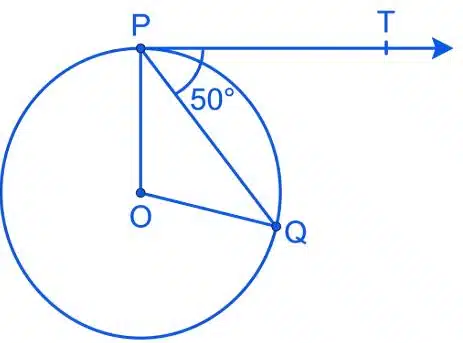
Given: $\angle QPT = 50^\circ$.
$\angle OPT = 90^\circ$ [ $Radius \perp Tangent $ ]
From the figure:
$\angle OPQ = \angle OPT – \angle QPT$
$\angle OPQ = 90^\circ – 50^\circ = 40^\circ$
In $\Delta OPQ$,
$OP = OQ$ (radii of the same circle), so the angles opposite to equal sides are equal:
$\angle OQP = \angle OPQ = 40^\circ$
In $\Delta OPQ$, we have
$\angle POQ + \angle OPQ + \angle OQP = 180^\circ$ [Angle Sum Property of a triangle]
$\implies \angle POQ + 40^\circ + 40^\circ = 180^\circ$
$\implies \angle POQ = 180^\circ – 80^\circ = 100^\circ$
Correct option is (b) $100^\circ$
123. A circle is of radius $3\text{ cm}$. The distance between two of its parallel tangents is:
(a) $12\text{ cm}$
(b) $3\text{ cm}$
(c) $6\text{ cm}$
(d) $4.5\text{ cm}$
$\mathbf{Sol^n.}$
Given radius of the circle, $r = 3\text{ cm}$.
Two parallel tangents always touch a circle at the opposite ends of a diameter. Therefore, the distance between two parallel tangents is equal to the diameter of the circle:
$\text{Distance} = 2 \times r = 2 \times 3 = 6\text{ cm}$
Correct option is (c) $6\text{ cm}$
124. In the given figure, $PQ$ and $PR$ are tangents to a circle centred at $O$. If $\angle QPR = 35^\circ$, then $\angle QOR$ is equal to:
(a) $70^\circ$
(b) $90^\circ$
(c) $135^\circ$
(d) $145^\circ$
$\mathbf{Sol^n.}$
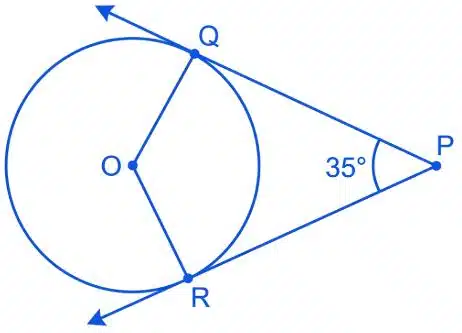
Given: $\angle QPR = 35^\circ$.
$\angle OQP = 90^\circ$ and $\angle ORP = 90^\circ$ [ $Radius \perp Tangent$ ]
In quadrilateral $OQPR$, we get
$\angle QOR + \angle OQP + \angle QPR + \angle ORP = 360^\circ$ [the sum of all four interior angles is $360^\circ$]
$\implies \angle QOR + 90^\circ + 35^\circ + 90^\circ = 360^\circ$
$\implies \angle QOR + 215^\circ = 360^\circ$
$\implies \angle QOR = 360^\circ – 215^\circ = 145^\circ$
Correct option is (d) $145^\circ$
125. If the perimeter of a given triangle is $38\text{ cm}$, then length $AP$ is equal to:
(a) $19\text{ cm}$
(b) $5\text{ cm}$
(c) $10\text{ cm}$
(d) $8\text{ cm}$
$\mathbf{Sol^n.}$
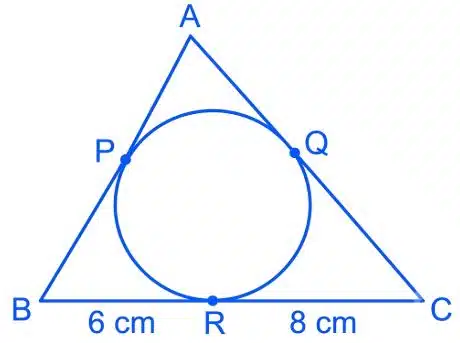
Given: Perimeter of $\Delta ABC = 38\text{ cm}$, $BR = 6\text{ cm}$, and $CR = 8\text{ cm}$.
We know that the lengths of tangents drawn from an external point to a circle are equal:
$BP = BR = 6\text{ cm}$
$CQ = CR = 8\text{ cm}$
$AQ = AP$
Now,
$\text{Perimeter of } \Delta ABC = AB + BC + AC = 38\text{ cm}$
$\implies (AP + BP) + (BR + CR) + (CQ + AQ) = 38$
$\implies (AP + 6) + (6 + 8) + (8 + AP) = 38$ [ Since, $AQ = AP$]
$\implies 2AP + 28 = 38$
$\implies 2AP = 38 – 28 = 10$
$\implies AP = \frac{10}{2} = 5\text{ cm}$
Correct option is (b) $5\text{ cm}$
126. Which of the following statements is not true?
(a) A number of secants can be drawn at any point on the circle.
(b) Only one tangent can be drawn at any point on a circle.
(c) A chord is a line segment joining two points on the circle.
(d) From a point inside a circle only two tangents can be drawn.
Soln.\mathbf{Sol^n.}
- Statement (a) is true.
- Statement (b) is true.
- Statement (c) is true by definition of a chord.
- Statement (d) is not true because every line passing through a point inside a circle intersects the circle at two distinct points, meaning no tangent (0 tangents) can be drawn from a point inside a circle.
Correct option is (d) From a point inside a circle only two tangents can be drawn.
Chapter 10 Circles: Miscellaneous Solutions: Very Short Answer (VSA) Type Questions
127. Prove that the tangents drawn at the ends of a diameter of a circle are parallel.
$\mathbf{Sol^n.}$
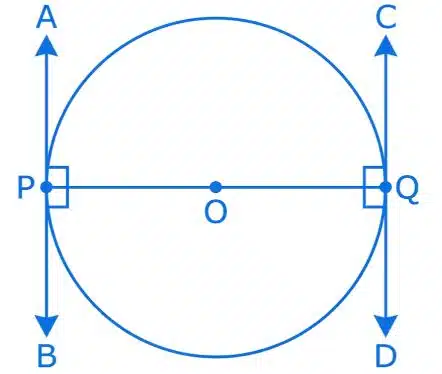
Given: A circle with centre $O$ and diameter $PQ$. Two tangents $AB$ and $CD$ are drawn at the ends $P$ and $Q$ of the diameter respectively.
To prove: $AB \parallel CD$
Proof: Since the tangent at any point of a circle is perpendicular to the radius through the point of contact:
$\therefore OP \perp AB \implies \angle OPB = 90^\circ$ and $OQ \perp CD \implies \angle OQC = 90^\circ$
$\therefore \angle OPB = \angle OQC = 90^\circ$
$\therefore AB \parallel CD$ [Since $\angle OPB$ and $\angle OQC$ are alternate interior angles and $PQ$ is the transversal]
Hence proved.
128. In the given figure, $PQ$ is a chord of the circle centered at $O$. $PT$ is a tangent to the circle at $P$. If $\angle QPT = 55^\circ$, then find $\angle PRQ$.
$\mathbf{Sol^n.}$
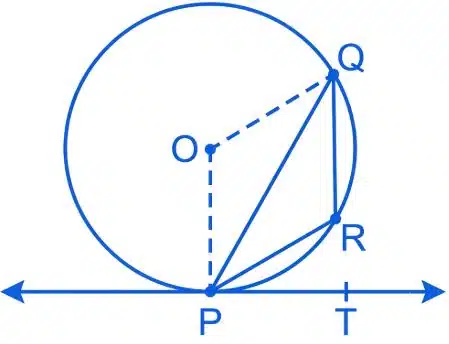
Given: $\angle QPT = 55^\circ$.
Construction: $OP$ and $OQ$ are joined.
Solution: Since the tangent at any point of a circle is perpendicular to the radius through the point of contact.
∴ $OP \perp PT \implies \angle OPT = 90^\circ$
From the figure:
$\angle OPQ = \angle OPT – \angle QPT $
$\angle OPQ = 90^\circ – 55^\circ $
∴ $\angle OPQ = 35^\circ$
In $\Delta OPQ$,
$OP = OQ$ [Radii of the same circle]
$\therefore \angle OQP = \angle OPQ = 35^\circ$ [Angles opposite to equal sides are equal]
In $\Delta OPQ$,
$\angle POQ + \angle OPQ + \angle OQP = 180^\circ$[Angle Sum Property of a triangle]
$\implies \angle POQ + 35^\circ + 35^\circ = 180^\circ$
$\implies \angle POQ = 180^\circ – 70^\circ = 110^\circ$
Now, $\text{Major Reflex } \angle POQ = 360^\circ – \angle POQ $
$= 360^\circ – 110^\circ = 250^\circ$
We know that the angle subtended by an arc at the centre is double the angle subtended by it at any point on the remaining part of the circle.
$\therefore \angle PRQ = \frac{1}{2} \times \text{Reflex } \angle POQ $
$\angle PRQ = \frac{1}{2} \times 250^\circ $
$\angle PRQ = 125^\circ$
Therefore, $\angle PRQ = \mathbf{125^\circ}$.
129. In two concentric circles, a chord of length $8\text{ cm}$ of the larger circle touches the smaller circle. If the radius of the larger circle is $5\text{ cm}$, then find the radius of the smaller circle.
$\mathbf{Sol^n.}$
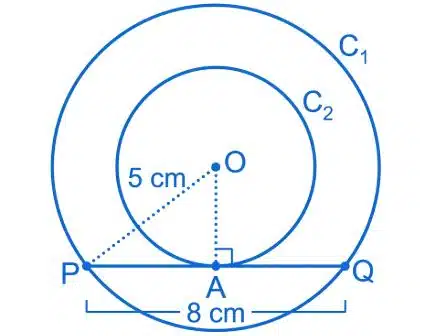
Let $C_1$ and $C_2$ be the two concentric circles with common centre $O$. Let $PQ = 8\text{ cm}$ be the chord of the larger circle $C_1$, and it touch the smaller circle $C_2$ at the point $A$.
$OA$ and $OP$ are joined.
Here:
- $OP = 5\text{ cm}$
- $\angle OAP = 90^\circ$ [Since $PQ$ is a tangent to the smaller circle $C_2$ at $A$ and $OA$ is its radius]
Since the perpendicular drawn from the centre of a circle to a chord bisects the chord:
$AP = \frac{PQ}{2} = \frac{8}{2} = 4\text{ cm}$
In right-angled $\Delta OAP$, by Pythagoras Theorem, we have:
$OP^2 = OA^2 + AP^2$
$\implies (5)^2 = OA^2 + (4)^2$
$\implies 25 = OA^2 + 16$
$\implies OA^2 = 25 – 16$
$\implies OA^2 = 9$
$\implies OA = \sqrt{9}$
$\implies OA = 3\text{ cm}$
Therefore, the radius of the smaller circle is $3\text{ cm}$.
130. In the given figure, $PT$ is a tangent to the circle centered at $O$. $OC$ is perpendicular to chord $AB$. Prove that $PA \cdot PB = PC^2 – AC^2$.
$\mathbf{Sol^n.}$
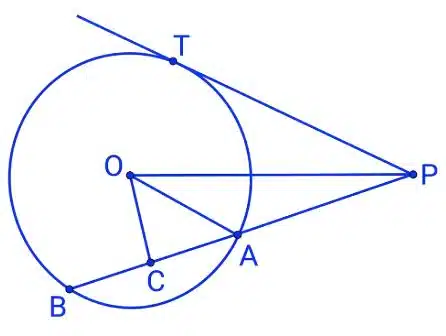
Given: $PT$ is a tangent to the circle with centre $O$, and $OC \perp AB$.
To prove: $PA \cdot PB = PC^2 – AC^2$
Proof: Since $OC \perp AB$, and the perpendicular drawn from the centre of a circle to a chord bisects the chord:
$\therefore AC = BC \quad \text{— (1)}$
From the figure, we have
$PA = PC – AC \quad \text{— (2)}$
$PB = PC + BC = PC + AC \quad [\text{From (1)}] \quad \text{— (3)}$
Multiplying equations (2) and (3), we get:
$PA \cdot PB = (PC – AC)(PC + AC)$
$\implies PA \cdot PB = PC^2 – AC^2 $
Hence proved.
131. (a) In the given figure, $PA$ and $PB$ are tangents to a circle centred at $O$. Prove that:
(i) $OP$ bisects $\angle APB$
(ii) $OP$ is the right bisector of $AB$
$\mathbf{Sol^n.}$
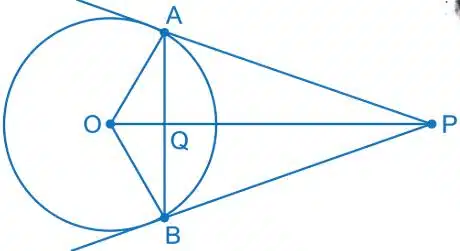
Given: $PA$ and $PB$ are two tangents drawn from an external point $P$ to a circle with centre $O$, touching it at $A$ and $B$ respectively. Let $OP$ intersect chord $AB$ at $Q$.
To prove:
(i) $OP$ bisects $\angle APB$, i.e., $\angle APO = \angle BPO$
(ii) $OP$ is the right bisector of $AB$, i.e., $AQ = BQ$ and $\angle AQP = \angle BQP = 90^\circ$
Proof:
(i) In $\Delta OAP$ and $\Delta OBP$, we have:
- $PA = PB$ [Lengths of tangents drawn from an external point to a circle are equal]
- $OA = OB$ [Radii of the same circle]
- $OP = OP$ [Common side]
$\therefore \Delta OAP \cong \Delta OBP$ [By SSS congruence rule]
$\implies \angle APO = \angle BPO$ [By CPCT]
i.e., $\angle APQ = \angle BPQ \quad \text{— (1)}$
Therefore, $OP$ bisects $\angle APB$.
(ii) Now, in $\Delta AQP$ and $\Delta BQP$, we have:
- $PA = PB$ [Tangents from external point $P$]
- $\angle APQ = \angle BPQ$ [From (1)]
- $PQ = PQ$ [Common side]
$\therefore \Delta AQP \cong \Delta BQP$ [By SAS congruence rule]
$\implies AQ = BQ \quad \text{(By CPCT)}$ and
$\angle AQP = \angle BQP \quad \text{(By CPCT)} \quad \text{— (2)}$
Since $AB$ is a straight line,
∴$\angle AQP + \angle BQP = 180^\circ$
$\implies \angle AQP + \angle AQP = 180^\circ \quad [\text{From (2)}]$
$\implies 2\angle AQP = 180^\circ$
$\implies \angle AQP = 90^\circ$
$\therefore AQ = BQ$ and $\angle AQP = \angle BQP = 90^\circ$.
Hence, $OP$ is the right bisector of $AB$.
Hence proved.
131. (b) Prove that the lengths of tangents drawn from an external point to a circle are equal.
$\mathbf{Sol^n.}$ Theorem 10.2
132. In the given figure, $O$ is the centre of the circle and $PA$ is a tangent to the circle. If $\angle OAB = 60^\circ$, then $\angle OPA$ is equal to:
(a) $60^\circ$ (b) $30^\circ$ (c) $15^\circ$ (d) $20^\circ$
$\mathbf{Sol^n.}$
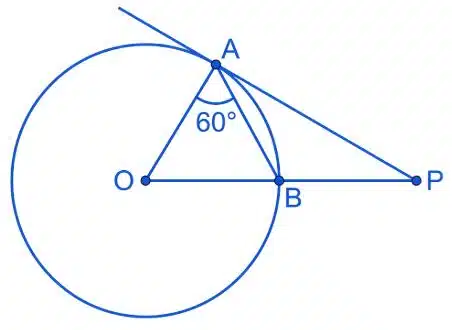
Given: $\angle OAB = 60^\circ$.
$\angle OAP = 90^\circ$
From the figure:
$\angle BAP = \angle OAP – \angle OAB $
$\angle BAP= 90^\circ – 60^\circ = 30^\circ$
Now, in $\Delta OAB$, $OA = OB$ [Radii of the same circle]
$\therefore \angle OBA = \angle OAB = 60^\circ$ [Angles opposite to equal sides are equal]
In $\Delta ABP$, we have
$\angle OBA = \angle BAP + \angle OPA$ [ an exterior angle is equal to the sum of the two opposite interior angles ]
$\implies 60^\circ = 30^\circ + \angle OPA$
$\implies \angle OPA = 60^\circ – 30^\circ = 30^\circ$
Correct option is (b) $30^\circ$
133. In the given figure, tangents $AB$ and $AC$ are drawn to a circle centred at $O$. If $\angle OAB = 60^\circ$ and $OB = 5\text{ cm}$, find lengths $OA$ and $AC$.
$\mathbf{Sol^n.}$
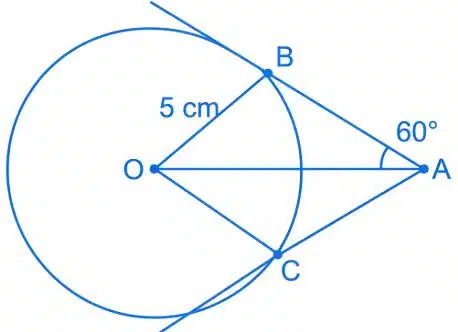
Given: $OB = 5\text{ cm}$ and $\angle OAB = 60^\circ$.
Since the tangent at any point of a circle is perpendicular to the radius through the point of contact:
$OB \perp AB \implies \angle OBA = 90^\circ$
In right-angled $\Delta OBA$:
$\sin 60^\circ = \frac{OB}{OA}$
$\implies \frac{\sqrt{3}}{2} = \frac{5}{OA}$
$\implies OA = \frac{10}{\sqrt{3}}\text{ cm}$
$\implies OA = \frac{10\sqrt{3}}{3}\text{ cm}$
$\tan 60^\circ = \frac{OB}{AB}$
$\implies \sqrt{3} = \frac{5}{AB}$
$\implies AB = \frac{5}{\sqrt{3}}\text{ cm}$
$\implies AB = \frac{5\sqrt{3}}{3}\text{ cm}$
We know that the lengths of tangents drawn from an external point to a circle are equal:
$\therefore AC = AB = \frac{5}{\sqrt{3}}\text{ cm} = \frac{5\sqrt{3}}{3}\text{ cm}$
134. $ABC$ is an isosceles triangle with $AB = AC$, circumscribed about a circle. Prove that $BC$ is bisected at $E$.
$\mathbf{Sol^n.}$
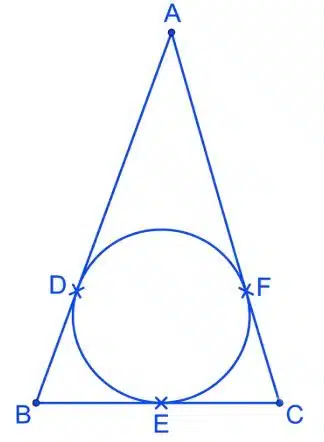
Given: $\Delta ABC$ is an isosceles triangle with $AB = AC$, circumscribed about a circle touching the sides $AB, BC$, and $CA$ at points $D, E$, and $F$ respectively.
To prove: $BC$ is bisected at $E$, i.e., $BE = CE$.
Proof: We know that the lengths of tangents drawn from an external point to a circle are equal. Therefore:
- $AD = AF \quad \text{— (1)}$
- $BD = BE \quad \text{— (2)}$
- $CE = CF \quad \text{— (3)}$
Given that $AB = AC$:
$\implies AD + BD = AF + CF$
$\implies AF + BD = AF + CF \quad [\text{From (1)}]$
$\implies BD = CF$
$\implies BE = CE$ [from (2) and (3)]
Therefore, $BC$ is bisected at $E$.
Hence proved.
This Section Comprises Long Answer (LA) Type Questions
135. (a) A triangle $ABC$ is drawn to circumscribe a circle of radius $4\text{ cm}$ such that the segments $BD$ and $DC$ are of lengths $10\text{ cm}$ and $8\text{ cm}$ respectively. Find the lengths of the sides $AB$ and $AC$, if it is given that $\text{area } \Delta ABC = 90\text{ cm}^2$.
$\mathbf{Sol^n.}$
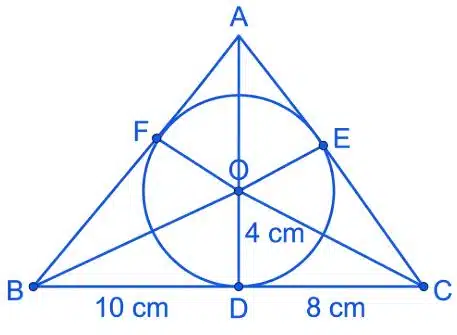
Given:
- Radius of circle, $r = 4\text{ cm}$
- $BD = 10\text{ cm}$ and $DC = 8\text{ cm}$
- $\text{Area of } \Delta ABC = 90\text{ cm}^2$
Let the circle touch the sides $AC$ and $AB$ at points $E$ and $F$ respectively. $OE, OF, OA, OB$, and $OC$ are joined. Here, $OD = OE = OF = 4\text{ cm}$.
We know that the lengths of tangents drawn from an external point to a circle are equal. Therefore:
- $BF = BD = 10\text{ cm}$
- $CE = CD = 8\text{ cm}$
Let $AF = AE = x\text{ cm}$. Now, the three sides of $\Delta ABC$ are:
- $BC = BD + DC = 10 + 8 = 18\text{ cm}$
- $AC = AE + EC = (x + 8)\text{ cm}$
- $AB = AF + FB = (x + 10)\text{ cm}$
Since $OD \perp BC$, $OE \perp AC$, $OF \perp AB$):
∴ $\text{Area}(\Delta ABC) = \text{Area}(\Delta OBC) + \text{Area}(\Delta OCA) + \text{Area}(\Delta OAB)$
$\implies 90 = \left(\frac{1}{2} \times BC \times OD\right) + \left(\frac{1}{2} \times AC \times OE\right) + \left(\frac{1}{2} \times AB \times OF\right)$
$\implies 90 = \left(\frac{1}{2} \times 18 \times 4\right) + \left(\frac{1}{2} \times (x + 8) \times 4\right) + \left(\frac{1}{2} \times (x + 10) \times 4\right)$
$\implies 90 = 36 + 2(x + 8) + 2(x + 10)$
$\implies 90 = 36 + 2x + 16 + 2x + 20$
$\implies 90 = 4x + 72$
$\implies 4x = 90 – 72$
$\implies 4x = 18$
$\implies x = \frac{18}{4} = 4.5\text{ cm}$
Therefore:
- $AB = x + 10 = 4.5 + 10 = \mathbf{14.5\text{ cm}}$
- $AC = x + 8 = 4.5 + 8 = \mathbf{12.5\text{ cm}}$
Therefore, the lengths of sides $AB$ and $AC$ are $14.5\text{ cm}$ and $12.5\text{ cm}$ respectively.
OR
135. (b) Two circles with centres $O$ and $O’$ of radii $6\text{ cm}$ and $8\text{ cm}$, respectively intersect at two points $P$ and $Q$ such that $OP$ and $O’P$ are tangents to the two circles. Find the length of the common chord $PQ$.
$\mathbf{Sol^n.}$
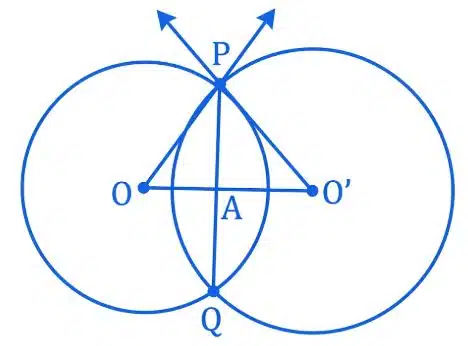
Given: Two circles with centres $O$ and $O’$ of radii $6\text{ cm}$ and $8\text{ cm}$ respectively intersect at two points $P$ and $Q$ such that $OP$ and $O’P$ are tangents to the two circles.
To find: Length of the common chord $PQ$.
Construction: Join $OO’$ and $PQ$. Let $OO’$ intersect $PQ$ at $A$.
Calculation:
Since the tangent to a circle is perpendicular to the radius through the point of contact.
$\angle OPO’ = 90^\circ$
In right-angled $\Delta OPO’$, by Pythagoras Theorem:
$(OO’)^2 = OP^2 + (O’P)^2$
$\implies (OO’)^2 = 6^2 + 8^2$
$\implies (OO’)^2 = 36 + 64$
$\implies (OO’)^2 = 100$
$\implies OO’ = \sqrt{100} = 10\text{ cm}$
We know that the line joining the centres of two intersecting circles is the perpendicular bisector of their common chord.
$\therefore OO’ \perp PQ$ and $PA = AQ$, i.e., $PQ = 2PA \quad \text{— (i)}$
Let $OA = x\text{ cm}$. Then, $O’A = (10 – x)\text{ cm}$.
In right-angled $\Delta OAP$, by Pythagoras Theorem:
$OP^2 = OA^2 + PA^2$
$\implies 6^2 = x^2 + PA^2$
$\implies PA^2 = 36 – x^2 \quad \text{— (ii)}$
In right-angled $\Delta O’AP$, by Pythagoras Theorem:
$(O’P)^2 = (O’A)^2 + PA^2$
$\implies 8^2 = (10 – x)^2 + PA^2$
$\implies PA^2 = 64 – (10 – x)^2 \quad \text{— (iii)}$
From equations (ii) and (iii), we get:
$36 – x^2 = 64 – (10 – x)^2$
$\implies 36 – x^2 = 64 – (100 – 20x + x^2)$
$\implies 36 – x^2 = 64 – 100 + 20x – x^2$
$\implies 36 = -36 + 20x$
$\implies 20x = 36 + 36$
$\implies 20x = 72$
$\implies x = \frac{72}{20} = 3.6\text{ cm}$
Substituting $x = 3.6$ in equation (ii):
$PA^2 = 36 – (3.6)^2$
$\implies PA^2 = 36 – 12.96$
$\implies PA^2 = 23.04$
$\implies PA = \sqrt{23.04} = 4.8\text{ cm}$
From equation (i):
$PQ = 2 \times PA$
$\implies PQ = 2 \times 4.8 = 9.6\text{ cm}$
Hence, the length of the common chord $PQ$ is $9.6\text{ cm}$.
136. Prove that the lengths of tangents drawn from an external point to a circle are equal. Using above result, find the length $BC$ of $\Delta ABC$. Given that, a circle is inscribed in $\Delta ABC$ touching the sides $AB, BC$ and $CA$ at $R, P$ and $Q$ respectively and $AB = 10\text{ cm}$, $AQ = 7\text{ cm}$, $CQ = 5\text{ cm}$.
$\mathbf{Sol^n.}$
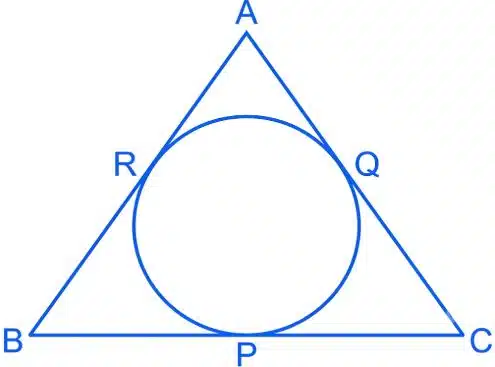
Part 1: Proof of Theorem 10.2
Part 2:
Given: $AB = 10\text{ cm}$, $AQ = 7\text{ cm}$, and $CQ = 5\text{ cm}$.
Since the lengths of tangents drawn from an external point to a circle are equal.
- $AR = AQ = 7\text{ cm}$
- $CP = CQ = 5\text{ cm}$
- $BP = BR$
Now, from the figure: $BR = AB – AR = 10 – 7 = 3\text{ cm}$
$\therefore BP = BR = 3\text{ cm}$
Now, $BC = BP + CP = 3 + 5 = 8\text{ cm}$
Therefore, the length of side $BC$ is $8\text{ cm}$.