
SEBA Class 10 Advanced Maths Chapter 9.3 Solutions: Coordinate Geometry
Looking for reliable and step-by-step SEBA Class 10 Advanced Maths Chapter 9.3 Solutions? In this article, we solved all the textual questions of Exercise 9.3 from the SEBA Class 10 New Advanced Mathematics book. We provide 100% accurate solutions on parallel lines, perpendicular lines, and angles between intersecting lines in a very simple way to help you score full marks in your upcoming HSLC exam.
See More:
- SEBA Class 10 Advanced Maths Chapter 9.1 Solutions
- SEBA Class 10 Advanced Maths Chapter 9.2 Solutions
10 Advanced Maths Chapter 9.3 Solutions
1. Show that each pair of lines given below are parallel :
(a) $3x – 4y + 1 = 0$, $4y – 3x + 7 = 0$
Soln : Given,
$3x – 4y + 1 = 0$ — (i)
$4y – 3x + 7 = 0 \implies -3x + 4y + 7 = 0$ — (ii)
From (i), we get
$a_1 = 3, \quad b_1 = -4$
$\therefore \frac{a_1}{b_1} = \frac{3}{-4} = -\frac{3}{4}$
From (ii), we get
$a_2 = -3, \quad b_2 = 4$
$\therefore \frac{a_2}{b_2} = \frac{-3}{4} = -\frac{3}{4}$
Since $\frac{a_1}{b_1} = \frac{a_2}{b_2}$,
$\therefore$ The given lines are parallel.
Showed.
(b) $l(x + y) + k = 0$, $l(x + y) – p = 0$
Soln :
The two given equations are:
$lx + ly + k = 0$ — (i)
$lx + ly – p = 0$ — (ii)
From (i), we get
$a_1 = l, \quad b_1 = l$
$\therefore \frac{a_1}{b_1} = \frac{l}{l} = 1$
From (ii), we get
$a_2 = l, \quad b_2 = l$
$\therefore \frac{a_2}{b_2} = \frac{l}{l} = 1$
Since $\frac{a_1}{b_1} = \frac{a_2}{b_2}$,
$\therefore$ The given lines are parallel.
Showed.
(c) $\frac{x}{3} + \frac{y}{6} – 1 = 0; \quad x + \frac{y}{2} = 8$
Soln :
The first line is:
$\frac{x}{3} + \frac{y}{6} – 1 = 0$
$\implies 2x + y – 6 = 0$ — (i)
The second line is:
$x + \frac{y}{2} = 8$
$\implies 2x + y = 16$
$\implies 2x + y – 16 = 0$ — (ii)
From (i), we get
$a_1 = 2, \quad b_1 = 1$
$\therefore \frac{a_1}{b_1} = \frac{2}{1} = 2$
From (ii), we get
$a_2 = 2, \quad b_2 = 1$
$\therefore \frac{a_2}{b_2} = \frac{2}{1} = 2$
Since $\frac{a_1}{b_1} = \frac{a_2}{b_2}$,
$\therefore$ The given lines are parallel.
Showed.
(d) $px + qy = r, \quad 4qy = s – 4px$
Soln :
The first line is:
$px + qy – r = 0$ — (i)
The second line is:
$4qy = s – 4px$
$\implies 4px + 4qy – s = 0$ — (ii)
From (i), we get
$a_1 = p, \quad b_1 = q$
$\therefore \frac{a_1}{b_1} = \frac{p}{q}$
From (ii), we get
$a_2 = 4p, \quad b_2 = 4q$
$\therefore \frac{a_2}{b_2} = \frac{4p}{4q} = \frac{p}{q}$
Since $\frac{a_1}{b_1} = \frac{a_2}{b_2}$,
$\therefore$ The given lines are parallel.
Showed.
2. Show that each of the following pairs of lines are perpendicular to one another :
(a) $4x – y + 9 = 0$, $\quad -x + 4y + 5 = 0$
Soln : Given,
$4x – y + 9 = 0$ — (i)
$-x + 4y + 5 = 0$ — (ii)
From (i) and (ii), we get
$a_1 = 4, \quad b_1 = -1$
$a_2 = -1, \quad b_2 = 4$
Now,
$a_1 a_2 + b_1 b_2 = (4) \times (-1) + (-1) \times (4)$
$= -4 – 4$
$= -8 \neq 0$
$\therefore$ The given lines are not perpendicular to one another.
Showed.
(b) $\frac{y}{a} – \frac{x}{b} + 1 = 0, \quad \frac{x}{a} + \frac{y}{b} – 1 = 0$
Soln :
The first line is:
$\frac{y}{a} – \frac{x}{b} + 1 = 0$
$\implies -\frac{1}{b}x + \frac{1}{a}y + 1 = 0$ — (i)
The second line is:
$\frac{x}{a} + \frac{y}{b} – 1 = 0$ — (ii)
From (i) and (ii), we get,
$a_1 = -\frac{1}{b}, \quad b_1 = \frac{1}{a}$
$a_2 = \frac{1}{a}, \quad b_2 = \frac{1}{b}$
Now,
$a_1 a_2 + b_1 b_2 = \left(-\frac{1}{b}\right) \times \left(\frac{1}{a}\right) + \left(\frac{1}{a}\right) \times \left(\frac{1}{b}\right)$
$= -\frac{1}{ab} + \frac{1}{ab}$
$= 0$
$\therefore$ The given lines are perpendicular to one another.
Showed.
(c) $2x + 6y + 4 = 0$, $\quad 3x – y + 1 = 0$
Soln :
Here,
$2x + 6y + 4 = 0$ — (i)
$3x – y + 1 = 0$ — (ii)
From (i) and (ii), we get,
$a_1 = 2, \quad b_1 = 6$
$a_2 = 3, \quad b_2 = -1$
Now,
$a_1 a_2 + b_1 b_2 = (2) \times (3) + (6) \times (-1)$
$= 6 – 6$
$= 0$
$\therefore$ The given lines are perpendicular to one another.
Showed.
3. Find the value of $\lambda$ such that the lines $2x – y + 7 = 0$ and $(\lambda – 2)x + (\lambda + 3)y – 5 = 0$ are parallel.
Soln :
The equations of the given lines are:
$2x – y + 7 = 0$ — (i)
$(\lambda – 2)x + (\lambda + 3)y – 5 = 0$ — (ii)
From (i) and (ii), we get,
$a_1 = 2, \quad b_1 = -1$
$a_2 = \lambda – 2, \quad b_2 = \lambda + 3$
Since the two lines are parallel, we have:
$\frac{a_1}{b_1} = \frac{a_2}{b_2}$
$\implies \frac{2}{-1} = \frac{\lambda – 2}{\lambda + 3}$
$\implies 2(\lambda + 3) = -1(\lambda – 2)$
$\implies 2\lambda + 6 = -\lambda + 2$
$\implies 2\lambda + \lambda = 2 – 6$
$\implies 3\lambda = -4$
$\implies \lambda = -\frac{4}{3}$
$\therefore$ Required value of $\lambda = -\frac{4}{3}$.
4. For what value of $k$ is the straight line $2x = ky + c$ is (i) parallel to, (ii) perpendicular to the straight line $6x + 7y – 9 = 0$.
Soln :
Given,
$2x = ky + c \implies 2x – ky – c = 0$ — (i)
$6x + 7y – 9 = 0$ — (ii)
From (i) and (ii), we get,
$a_1 = 2, \quad b_1 = -k$
$a_2 = 6, \quad b_2 = 7$
(i) When the two lines are parallel:
We know that if two lines are parallel, then:
$\frac{a_1}{b_1} = \frac{a_2}{b_2}$
$\implies \frac{2}{-k} = \frac{6}{7}$
$\implies -6k = 14$
$\implies k = -\frac{14}{6}$
$\therefore k = -\frac{7}{3}$
(ii) When the two lines are perpendicular:
We know that if two lines are perpendicular, then:
$a_1 a_2 + b_1 b_2 = 0$
$\implies (2) \times (6) + (-k) \times (7) = 0$
$\implies 12 – 7k = 0$
$\implies -7k = -12$
$\implies k = \frac{12}{7}$
$\therefore$ Required value of $k = \frac{12}{7}$
5. (a) Find the value of $k$ if the lines $2x + 3y + 4 = 0$ and $6x + ky – 7 = 0$ are parallel.
(b) Find the value of $d$ if the lines $5 – 3x – 7y = 0$ and $dx = 9y – 2$ are mutually perpendicular.
Soln :
Here,
$2x + 3y + 4 = 0$ — (i)
$6x + ky – 7 = 0$ — (ii)
From (i) and (ii) we get,
$a_1 = 2, \quad b_1 = 3$
$a_2 = 6, \quad b_2 = k$
Since the two lines are parallel, we have:
$\frac{a_1}{b_1} = \frac{a_2}{b_2}$
$\implies \frac{2}{3} = \frac{6}{k}$
$\implies 2k = 18$
$\implies k = \frac{18}{2}$
$\implies k = 9$
$\therefore$ Required value of $k = 9$.
(b) The equations of the given lines are:
$5 – 3x – 7y = 0 \implies -3x – 7y + 5 = 0$ — (i)
$dx = 9y – 2 \implies dx – 9y + 2 = 0$ — (ii)
From (i),$a_1 = -3, \quad b_1 = -7$
From (ii),$a_2 = d, \quad b_2 = -9$
Since the two lines are mutually perpendicular, we have:
$a_1 a_2 + b_1 b_2 = 0$
$\implies (-3) \times d + (-7) \times (-9) = 0$
$\implies -3d + 63 = 0$
$\implies -3d = -63$
$\implies d = \frac{-63}{-3}$
$\implies d = 21$
$\therefore$ Required value of $d = 21$.
6. Show that the line passing through the points $(-5, 6)$ and $(8, -4)$ is perpendicular to the line $13x – 20y = -20$.
Soln :
Equation of the line passing through $(-5, 6)$ and $(8, -4)$ is:
$y – 6 = \frac{-4 – 6}{8 – (-5)}[x – (-5)]$
$\implies y – 6 = \frac{-10}{8 + 5}(x + 5)$
$\implies y – 6 = \frac{-10}{13}(x + 5)$
$\implies 13(y – 6) = -10(x + 5)$
$\implies 13y – 78 = -10x – 50$
$\implies 10x + 13y – 28 = 0$ — (i)
And the given second line is:
$13x – 20y = -20 \implies 13x – 20y + 20 = 0$ — (ii)
From (i) and (ii) we get,
$a_1 = 10, \quad b_1 = 13$
$a_2 = 13, \quad b_2 = -20$
Now,
$a_1 a_2 + b_1 b_2 = (10) \times (13) + (13) \times (-20)$
$= 130 – 260$
$= -130 \neq 0$
(Note: Due to a typographical misprint in the textbook, the second equation is printed as $13x – 20y = -20$ instead of $13x – 10y = -20$)
Taking the second line as $13x – 10y + 20 = 0$:
From (i) and (ii) we get,
$a_1 = 10, \quad b_1 = 13$
$a_2 = 13, \quad b_2 = -10$ Now,
$a_1 a_2 + b_1 b_2 = (10) \times (13) + (13) \times (-10)$
$= 130 – 130$
$= 0$
$\therefore$ The two lines are perpendicular.
Showed.
7. Show that the line joining the points $(3, -4)$ and $(5, 7)$ is parallel to the line joining the points $(7, -6)$ and $(9, 5)$.
Soln :
Equation of the line joining $(3, -4)$ and $(5, 7)$ is:
$y – (-4) = \frac{7 – (-4)}{5 – 3}(x – 3)$
$\implies y + 4 = \frac{11}{2}(x – 3)$
$\implies 2y + 8 = 11x – 33$
$\implies 11x – 2y – 41 = 0$ — (i)
Equation of the line joining $(7, -6)$ and $(9, 5)$ is:
$y – (-6) = \frac{5 – (-6)}{9 – 7}(x – 7)$
$\implies y + 6 = \frac{11}{2}(x – 7)$
$\implies 2y + 12 = 11x – 77$
$\implies 11x – 2y – 89 = 0$ — (ii)
From (i) and (ii) we get,
$a_1 = 11, \quad b_1 = -2$
$a_2 = 11, \quad b_2 = -2$
Now,
$\frac{a_1}{b_1} = \frac{11}{-2} = -\frac{11}{2}$
$\frac{a_2}{b_2} = \frac{11}{-2} = -\frac{11}{2}$
Since $\frac{a_1}{b_1} = \frac{a_2}{b_2}$,
$\therefore$ The two lines are parallel.
Showed.
8. Find the equation of the line which passes through :(i) $(5, 3)$ and is perpendicular to $2x – 5y + 7 = 0$
(ii) $(5, -1)$ and is parallel to $2x + 10y + 7 = 0$
(iii) the mid point of the line joining $(6, -7)$ and $(2, -3)$ and is parallel to $3x + 4y + 5 = 0$
(iv) $(2, -3)$ and is perpendicular to $2x + 3y + 5 = 0$.
Soln :(i) The required line is perpendicular to $2x – 5y + 7 = 0$.
Therefore, its equation is of the form: [$bx – ay + k = 0$]
∴ $5x + 2y + k = 0$, where $k$ is a constant. — (1)
Again, the line passes through $(5, 3)$, so the coordinates will satisfy equation (1):
$5(5) + 2(3) + k = 0$
$\implies 25 + 6 + k = 0$
$\implies 31 + k = 0$
$\implies k = -31$ Putting $k = -31$ in (1), the required equation is:
$5x + 2y – 31 = 0$
(ii) The required line is parallel to $2x + 10y + 7 = 0$.
Therefore, its equation is of the form:
$2x + 10y + k = 0$, where $k$ is a constant. — (1)
Again, it is given that this line passes through $(5, -1)$:
$2(5) + 10(-1) + k = 0$
$\implies 10 – 10 + k = 0$
$\implies k = 0$
Putting $k = 0$ in (1), the required equation is:
$2x + 10y = 0$
or $x + 5y = 0$
(iii) The coordinates of the mid point of the line joining $(6, -7)$ and $(2, -3)$ are:
$\left(\frac{6 + 2}{2}, \frac{-7 + (-3)}{2}\right) = \left(\frac{8}{2}, \frac{-10}{2}\right) = (4, -5)$
Now, the required line is parallel to $3x + 4y + 5 = 0$.
Therefore, its equation is of the form:
$3x + 4y + k = 0$, where $k$ is a constant. — (1)
Since it passes through $(4, -5)$:
$3(4) + 4(-5) + k = 0$
$\implies 12 – 20 + k = 0$
$\implies -8 + k = 0$
$\implies k = 8$
Putting $k = 8$ in (1), the required equation is:
$3x + 4y + 8 = 0$
(iv) The required line is perpendicular to $2x + 3y + 5 = 0$.
Therefore, its equation is of the form:
$3x – 2y + k = 0$, where $k$ is a constant. — (1)
Again, it is given that this line passes through $(2, -3)$:
$3(2) – 2(-3) + k = 0$
$\implies 6 + 6 + k = 0$
$\implies 12 + k = 0$
$\implies k = -12$
Putting $k = -12$ in (1), the required equation is:
$3x – 2y – 12 = 0$
9. If the line joining $(4, 8)$ and $(-2, 6)$ is perpendicular to the line joining $(8, 12)$ and $(\alpha, 24)$ then find the value of $\alpha$. What will be the value of $\alpha$ if those two lines are parallel?
Soln :
Let the given points be $A(4, 8)$, $B(-2, 6)$, $C(8, 12)$, and $D(\alpha, 24)$.
Let $m_1$ be the gradient of the line joining $A(4, 8)$ and $B(-2, 6)$.
∴ $m_1 = \frac{6 – 8}{-2 – 4} = \frac{-2}{-6} = \frac{1}{3}$
Let $m_2$ be the gradient of the line joining $C(8, 12)$ and $D(\alpha, 24)$.
∴ $m_2 = \frac{24 – 12}{\alpha – 8} = \frac{12}{\alpha – 8}$
Case (i): When the two lines are perpendicular
We know that if two lines are perpendicular, then:
$m_1 \cdot m_2 = -1$
$\implies \left(\frac{1}{3}\right) \times \left(\frac{12}{\alpha – 8}\right) = -1$
$\implies \frac{4}{\alpha – 8} = -1$
$\implies 4 = -(\alpha – 8)$
$\implies 4 = -\alpha + 8$
$\implies \alpha = 8 – 4$
$\implies \alpha = 4$
Case (ii): When the two lines are parallel
We know that if two lines are parallel, then:
$m_1 = m_2$
$\implies \frac{1}{3} = \frac{12}{\alpha – 8}$
$\implies \alpha – 8 = 36$
$\implies \alpha = 36 + 8$
$\implies \alpha = 44$
$\therefore$ When the lines are perpendicular, $\alpha = 4$; and when the lines are parallel, $\alpha = 44$.
10. Find the angle between the following pairs of lines :(i) $x – \sqrt{3}y + 1 = 0 \quad \text{and} \quad \sqrt{3}x – y = 4$
Soln :
From the first line, we get
$x – \sqrt{3}y + 1 = 0$
$\implies \sqrt{3}y = x + 1$
$\implies y = \frac{1}{\sqrt{3}}x + \frac{1}{\sqrt{3}}$
$\therefore$ Gradient of the first line, $m_1 = \frac{1}{\sqrt{3}}$
From the second line, we have
$\sqrt{3}x – y = 4$
$\implies y = \sqrt{3}x – 4$
$\therefore$ Gradient of the second line, $m_2 = \sqrt{3}$
Let $\theta$ be the acute angle between the two lines. Then,
$\tan\theta = \left\vert{}\frac{m_2 – m_1}{1 + m_1 m_2}\right\vert{}$
$= \left\vert{}\frac{\sqrt{3} – \frac{1}{\sqrt{3}}}{1 + \left(\frac{1}{\sqrt{3}}\right)(\sqrt{3})}\right\vert{}$
$= \left\vert{}\frac{\frac{3 – 1}{\sqrt{3}}}{1 + 1}\right\vert{}$
$= \left\vert{}\frac{\frac{2}{\sqrt{3}}}{2}\right\vert{}$
$= \left\vert{}\frac{1}{\sqrt{3}}\right\vert{} = \frac{1}{\sqrt{3}} = \tan 30^\circ$
$\therefore \theta = 30^\circ$
And the obtuse angle between the lines is: $\phi = 180^\circ – \theta = 180^\circ – 30^\circ = 150^\circ$
$\therefore$ The angle between the lines is $30^\circ \text{ or } 150^\circ$.
(ii) $4x + 2y – 7 = 0 \quad \text{and} \quad x + 3y – 5 = 0$
Soln :
From the first line, we have,
$4x + 2y – 7 = 0$
$\implies 2y = -4x + 7$
$\implies y = -2x + \frac{7}{2}$
$\therefore$ Gradient of the first line, $m_1 = -2$
From the second line, we get,
$x + 3y – 5 = 0$
$\implies 3y = -x + 5$
$\implies y = -\frac{1}{3}x + \frac{5}{3}$
$\therefore$ Gradient of the second line, $m_2 = -\frac{1}{3}$
Let $\theta$ be the acute angle between the two lines. Then,
$\tan\theta = \left\vert{}\frac{m_2 – m_1}{1 + m_1 m_2}\right\vert{}$
$= \left\vert{}\frac{-\frac{1}{3} – (-2)}{1 + (-2)\left(-\frac{1}{3}\right)}\right\vert{}$
$= \left\vert{}\frac{-\frac{1}{3} + 2}{1 + \frac{2}{3}}\right\vert{}$
$= \left\vert{}\frac{\frac{5}{3}}{\frac{5}{3}}\right\vert{}$
$= \vert{}1\vert{} = 1 = \tan 45^\circ$
$\therefore \theta = 45^\circ$
And the obtuse angle between the lines is: $\phi = 180^\circ – \theta = 180^\circ – 45^\circ = 135^\circ$
$\therefore$ The angle between the lines is $45^\circ \text{ or } 135^\circ$.
(iii) $2x – 4y + 5 = 0 \quad \text{and} \quad y – 3x – 7 = 0$
Soln :
From the first line, we get,
$2x – 4y + 5 = 0$
$\implies 4y = 2x + 5$
$\implies y = \frac{1}{2}x + \frac{5}{4}$
$\therefore$ Gradient of the first line, $m_1 = \frac{1}{2}$
From the second line, we get,
$y – 3x – 7 = 0$
$\implies y = 3x + 7$
$\therefore$ Gradient of the second line, $m_2 = 3$
Let $\theta$ be the acute angle between the two lines. Then,
$\tan\theta = \left\vert{}\frac{m_2 – m_1}{1 + m_1 m_2}\right\vert{}$
$= \left\vert{}\frac{3 – \frac{1}{2}}{1 + \left(\frac{1}{2}\right)(3)}\right\vert{}$
$= \left\vert{}\frac{\frac{5}{2}}{1 + \frac{3}{2}}\right\vert{}$
$= \left\vert{}\frac{\frac{5}{2}}{\frac{5}{2}}\right\vert{}$
$= \vert{}1\vert{} = 1 = \tan 45^\circ$
$\therefore \theta = 45^\circ$
And the obtuse angle between the lines is: $\phi = 180^\circ – \theta = 180^\circ – 45^\circ = 135^\circ$
$\therefore$ The angle between the lines is $45^\circ \text{ or } 135^\circ$.
11. Find the acute angle between the following pair of lines :(a) $\sqrt{3}x – y + 2 = 0, \quad x – \sqrt{3}y – 4 = 0$
Soln :
From the first line, we get,
$\sqrt{3}x – y + 2 = 0 $
$\implies y = \sqrt{3}x + 2$
$\therefore$ Gradient of the first line, $m_1 = \sqrt{3}$
From the second line, we get,
$x – \sqrt{3}y – 4 = 0 $
$\implies \sqrt{3}y = x – 4 $
$\implies y = \frac{1}{\sqrt{3}}x – \frac{4}{\sqrt{3}}$
$\therefore$ Gradient of the second line, $m_2 = \frac{1}{\sqrt{3}}$
Let $\theta$ be the acute angle between the lines. Then,
$\tan\theta = \left\vert{}\frac{m_2 – m_1}{1 + m_1 m_2}\right\vert{}$
$= \left\vert{}\frac{\frac{1}{\sqrt{3}} – \sqrt{3}}{1 + \left(\frac{1}{\sqrt{3}}\right)(\sqrt{3})}\right\vert{}$
$= \left\vert{}\frac{\frac{1 – 3}{\sqrt{3}}}{1 + 1}\right\vert{}$
$= \left\vert{}\frac{-\frac{2}{\sqrt{3}}}{2}\right\vert{}$
$= \left\vert{}-\frac{1}{\sqrt{3}}\right\vert{} $
$= \frac{1}{\sqrt{3}} $
$= \tan 30^\circ$
$\therefore \theta = 30^\circ$
(b) $2\sqrt{3}x – 2y + 5 = 0, \quad 5x – 5\sqrt{3}y + 7 = 0$
Soln :
From the first line, we get,
$2\sqrt{3}x – 2y + 5 = 0 $
$\implies 2y = 2\sqrt{3}x + 5 $
$\implies y = \sqrt{3}x + \frac{5}{2}$
$\therefore$ Gradient of the first line, $m_1 = \sqrt{3}$
From the second line, we get,
$5x – 5\sqrt{3}y + 7 = 0 $
$\implies 5\sqrt{3}y = 5x + 7 $
$\implies y = \frac{1}{\sqrt{3}}x + \frac{7}{5\sqrt{3}}$
$\therefore$ Gradient of the second line, $m_2 = \frac{1}{\sqrt{3}}$
Let $\theta$ be the acute angle between the lines. Then:
$\tan\theta = \left\vert{}\frac{m_2 – m_1}{1 + m_1 m_2}\right\vert{}$
$= \left\vert{}\frac{\frac{1}{\sqrt{3}} – \sqrt{3}}{1 + \left(\frac{1}{\sqrt{3}}\right)(\sqrt{3})}\right\vert{}$
$= \left\vert{}\frac{-\frac{2}{\sqrt{3}}}{2}\right\vert{}$
$= \left\vert{}-\frac{1}{\sqrt{3}}\right\vert{} $
$= \frac{1}{\sqrt{3}} $
$= \tan 30^\circ$
$\therefore \theta = 30^\circ$
(c) $y = (2 – \sqrt{3})x + 5, \quad y = (2 + \sqrt{3})x – 2$
Soln : Given,
$y = (2 – \sqrt{3})x + 5 $
$y = (2 + \sqrt{3})x – 2$
∴ Gradient of the first line, $m_1 = 2 – \sqrt{3}$
Gradient of the second line, $m_2 = 2 + \sqrt{3}$
Let $\theta$ be the acute angle between the lines. Then:
$\tan\theta = \left\vert{}\frac{m_2 – m_1}{1 + m_1 m_2}\right\vert{}$
$= \left\vert{}\frac{(2 + \sqrt{3}) – (2 – \sqrt{3})}{1 + (2 + \sqrt{3})(2 – \sqrt{3})}\right\vert{}$
$= \left\vert{}\frac{2 + \sqrt{3} – 2 + \sqrt{3}}{1 + (2^2 – (\sqrt{3})^2)}\right\vert{}$
$= \left\vert{}\frac{2\sqrt{3}}{1 + (4 – 3)}\right\vert{}$
$= \left\vert{}\frac{2\sqrt{3}}{1 + 1}\right\vert{}$
$= \left\vert{}\frac{2\sqrt{3}}{2}\right\vert{} $
$= \sqrt{3} $
$= \tan 60^\circ$
$\therefore \theta = 60^\circ$
12. Find the angle between the lines $x = 5$ and $\sqrt{3}x – y + 6 = 0$.
Soln :
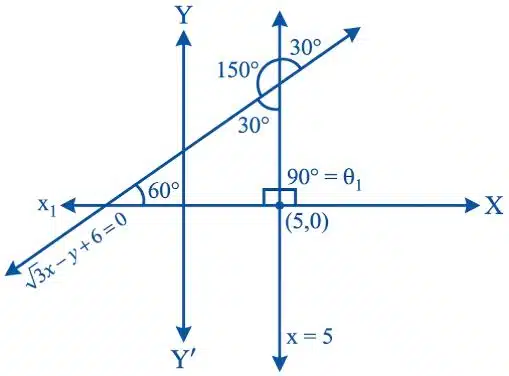
The first line is $x = 5$, which is parallel to the Y-axis.
Therefore, its inclination with the positive X-axis is $\theta_1 = 90^\circ$.
The second line is:$\sqrt{3}x – y + 6 = 0$
$\implies y = \sqrt{3}x + 6$
So, gradient of the second line is $m_2 = \sqrt{3}$.
If $\theta_2$ is the inclination of the second line with the positive X-axis, then:
$\tan\theta_2 = \sqrt{3} $
$\tan\theta_2 = \tan 60^\circ$
$\implies \theta_2 = 60^\circ$
Since the first line makes an angle of $90^\circ$ with the X-axis and the second line makes an angle of $60^\circ$ with the X-axis, the acute angle between the two lines is:
$\theta = \theta_1 – \theta_2 $
$\theta = 90^\circ – 60^\circ = 30^\circ$
$\therefore$ The angle between the lines is $30^\circ$.
$\therefore$ The obtuse angle between the lines is $150^\circ$.
13. Find the equations of the lines which pass through the point $(3, 2)$ and each of which makes an angle of $45^\circ$ with the line $x – 2y – 3 = 0$.
Soln :
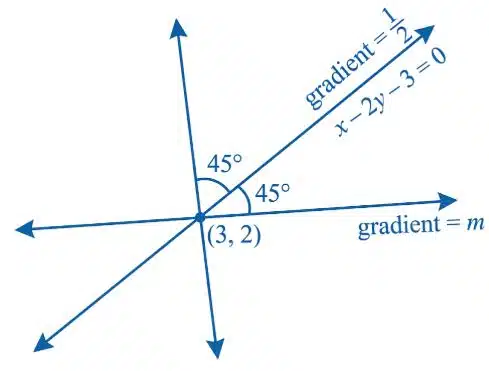
Let the gradient of one of the required lines be $m$.
The given line is:
$x – 2y – 3 = 0$
$\implies 2y = x – 3$
$\implies y = \frac{1}{2}x – \frac{3}{2}$
$\therefore$ Gradient of the given line, $m_2 = \frac{1}{2}$
Now, applying the formula $\tan\theta = \pm \frac{m_2 – m_1}{1 + m_1 m_2}$ (taking $m_1 = m$ and $m_2 = \frac{1}{2}$)
$\tan 45^\circ = \pm \frac{\frac{1}{2} – m}{1 + \frac{1}{2} \cdot m}$
$\implies 1 = \pm \frac{\frac{1 – 2m}{2}}{\frac{2 + m}{2}}$
$\implies 1 = \pm \frac{1 – 2m}{2 + m}$
$\implies 2 + m = \pm(1 – 2m)$
Considering the $+$ve sign:
$2 + m = 1 – 2m$
$\implies m + 2m = 1 – 2$
$\implies 3m = -1$
$\implies m = -\frac{1}{3}$
Considering the $-$ve sign:
$2 + m = -(1 – 2m)$
$\implies 2 + m = -1 + 2m$
$\implies m – 2m = -1 – 2$
$\implies -m = -3$
$\implies m = 3$
Now, the required equations of the lines passing through the point $P(3, 2)$ are:
(i) When $m = -\frac{1}{3}$ and the point is $(3, 2)$:
$y – 2 = -\frac{1}{3}(x – 3)$
$\implies 3(y – 2) = -1(x – 3)$
$\implies 3y – 6 = -x + 3$
$\implies x + 3y – 6 – 3 = 0$
$\implies x + 3y – 9 = 0$
(ii) When $m = 3$ and the point is $(3, 2)$:
$y – 2 = 3(x – 3)$
$\implies y – 2 = 3x – 9$
$\implies 3x – y – 9 + 2 = 0$
$\implies 3x – y – 7 = 0$
$\therefore$ The equations of the required lines are $3x – y – 7 = 0$ and $x + 3y – 9 = 0$.
14. (a) The coordinates of the three vertices of a triangle are $(0, 3)$, $(2, -3)$ and $(3, 4)$ in the given order. Find the equations of the perpendiculars drawn from the vertices to the opposite sides.
Soln :
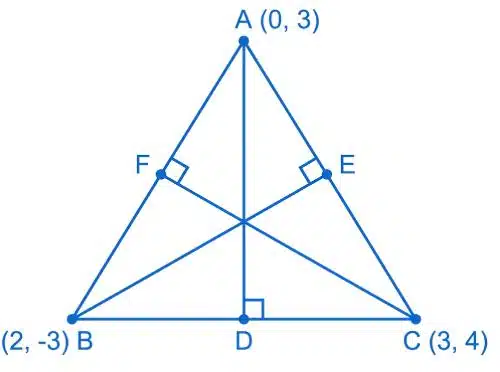
(a) Let the vertices of $\Delta ABC$ be $A(0, 3)$, $B(2, -3)$, and $C(3, 4)$.
Let $AD \perp BC$, $BE \perp CA$, and $CF \perp AB$ are drawn from the vertices to the opposite sides.
Equation of altitude $AD$ (perpendicular to $BC$):
Gradient of $BC = \frac{4 – (-3)}{3 – 2} = \frac{4 + 3}{1} = 7$
Since $AD \perp BC$, gradient of $AD = -\frac{1}{7}$
$\therefore$ Equation of $AD$ passing through $A(0, 3)$ is:
$y – 3 = -\frac{1}{7}(x – 0)$
$\implies 7(y – 3) = -x$
$\implies 7y – 21 = -x$
$\implies x + 7y – 21 = 0$ — (i)
Equation of altitude $BE$ (perpendicular to $CA$):
Gradient of $CA = \frac{3 – 4}{0 – 3} = \frac{-1}{-3} = \frac{1}{3}$
Since $BE \perp CA$, gradient of $BE = -3$
$\therefore$ Equation of $BE$ passing through $B(2, -3)$ is:
$y – (-3) = -3(x – 2)$
$\implies y + 3 = -3x + 6$
$\implies 3x + y + 3 – 6 = 0$
$\implies 3x + y – 3 = 0$ — (ii)
Equation of altitude $CF$ (perpendicular to $AB$):
Gradient of $AB = \frac{-3 – 3}{2 – 0} = \frac{-6}{2} = -3$
Since $CF \perp AB$, gradient of $CF = \frac{1}{3}$
$\therefore$ Equation of $CF$ passing through $C(3, 4)$ is:
$y – 4 = \frac{1}{3}(x – 3)$
$\implies 3(y – 4) = x – 3$
$\implies 3y – 12 = x – 3$
$\implies x – 3y – 3 + 12 = 0$
$\implies x – 3y + 9 = 0$ — (iii)
$\therefore$ The equations of the perpendiculars are $x + 7y – 21 = 0$, $3x + y – 3 = 0$, and $x – 3y + 9 = 0$.
14(b) From the question 14(a), you have the three equations of the altitudes of the triangle. Can you now show that they are concurrent? What are the coordinates of the point at which all the three altitudes meet?
Solution:
Here, the equations of the altitudes are
$x + 7y – 21 = 0$—-(i)
$3x + y – 3 = 0$—–(ii)
and $x – 3y + 9 = 0$—–(iii)
Subtracting equation (iii) from equation (i), we get
$(x + 7y – 21) – (x – 3y + 9) = 0$
$\implies x + 7y – 21 – x + 3y – 9 = 0$
$\implies 10y – 30 = 0$
$\implies 10y = 30$
$\implies y = 3$
Putting $y = 3$ in equation (i):
$x + 7(3) – 21 = 0$
$\implies x + 21 – 21 = 0$
$\implies x = 0$
Thus, the altitudes $AD$ and $CF$ intersect at the point $(0, 3)$.
Now, substituting $x = 0$ and $y = 3$ in the L.H.S. of equation (ii):
$\text{L.H.S.} = 3(0) + 3 – 3 $
$= 0 + 3 – 3 = 0 = \text{R.H.S.}$
∴ $BE$ also passes through the point $(0, 3)$.
Since the coordinates $(0, 3)$ satisfy all three equations (i), (ii), and (iii), the three altitudes of the triangle are concurrent.
$\therefore$ The coordinates of the point at which all three altitudes meet are $(0, 3)$.
15. From the question (7) above, the given points will give you two parallel lines. Now if you are to determine the equation of at least one line which is perpendicular to them, then how will you find that equation?
(Hint: Find the mid point of any one of the line segments. Then find the equation passing through this point and perpendicular to the line segment)
Soln :
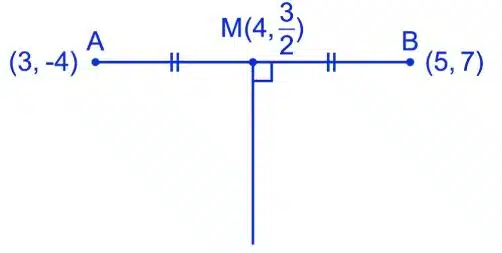
In Question (7), the first line segment joins the points $A(3, -4)$ and $B(5, 7)$.
The mid-point of $AB$ is,
$\text{Mid-point } M = \left(\frac{3 + 5}{2}, \frac{-4 + 7}{2}\right) $
$= \left(\frac{8}{2}, \frac{3}{2}\right) $
$= \left(4, \frac{3}{2}\right)$Now, the gradient of the line segment $AB$ is:
$m_1 = \frac{7 – (-4)}{5 – 3} = \frac{7 + 4}{2} = \frac{11}{2}$
Since the required line is perpendicular to $AB$, let its gradient be $m_2$. Then:
$m_1 \cdot m_2 = -1$
$\implies \frac{11}{2} \cdot m_2 = -1$
$\implies m_2 = -\frac{2}{11}$
The equation of the line passing through $M\left(4, \frac{3}{2}\right)$ with gradient $m_2 = -\frac{2}{11}$ is:
$y – \frac{3}{2} = -\frac{2}{11}(x – 4)$
$\implies \frac{2y – 3}{2} = -\frac{2(x – 4)}{11}$
$\implies 11(2y – 3) = -4(x – 4)$
$\implies 22y – 33 = -4x + 16$
$\implies 4x + 22y – 33 – 16 = 0$
$\implies 4x + 22y – 49 = 0$
$\therefore$ The equation of a line perpendicular to the parallel lines is $4x + 22y – 49 = 0$
16. Find the coordinates of the foot of the perpendicular drawn from the point $(6, 8)$ upon the line joining the points $(1, 5)$ and $(9, 3)$.
Soln :
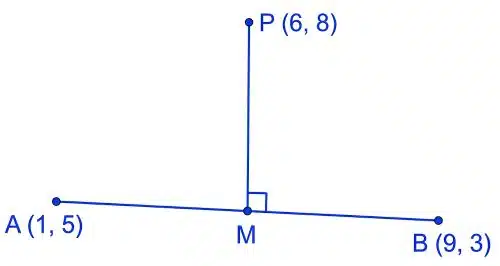
Let $P(6, 8)$ be the given point and let the given line segment join $A(1, 5)$ and $B(9, 3)$.
Let $M$ be the foot of the perpendicular drawn from $P$ upon $AB$ (so $PM \perp AB$).
Gradient of line $AB$ is:
$m_1 = \frac{3 – 5}{9 – 1} = \frac{-2}{8} = -\frac{1}{4}$
Equation of line $AB$ passing through $A(1, 5)$ is:
$y – 5 = -\frac{1}{4}(x – 1)$
$\implies 4(y – 5) = -1(x – 1)$
$\implies 4y – 20 = -x + 1$
$\implies x + 4y – 21 = 0$ — (i)
Again,
Since $PM \perp AB$, let the gradient of $PM$ be $m_2$. Then:
$m_1 \cdot m_2 = -1$
$\implies \left(-\frac{1}{4}\right) \cdot m_2 = -1$
$\implies m_2 = 4$
Equation of line $PM$ passing through $P(6, 8)$ is:
$y – 8 = 4(x – 6)$
$\implies y – 8 = 4x – 24$
$\implies 4x – y – 16 = 0$
$\implies y = 4x – 16$ — (ii)
For finding the coordinates of $M$
Substituting $y = 4x – 16$ from equation (ii) into equation (i):
$x + 4(4x – 16) – 21 = 0$
$\implies x + 16x – 64 – 21 = 0$
$\implies 17x – 85 = 0$
$\implies 17x = 85$
$\implies x = \frac{85}{17} = 5$
Putting $x = 5$ in equation (ii):
$y = 4(5) – 16 = 20 – 16 = 4$
$\therefore$ The coordinates of the foot of the perpendicular are $(5, 4)$.