
SEBA Class 10 Advanced Maths Chapter 9.2 Solutions: Coordinate Geometry
Here, you will get simple and reliable SEBA Class 10 Advanced Maths Chapter 9.2 Solutions for the upcoming HSLC board examination. In this article, we solved all the textual exercises of Chapter 9.2 (Equations of Straight Lines) from the SEBA Class 10 New Advanced Mathematics textbook.
Class 10 Advanced Maths Chapter 9.2 Solutions
See More:
- SEBA Class 10 Advanced Maths Chapter 9.1 Solutions
- SEBA Class 10 Advanced Maths Chapter 9.3 Solutions
1. Find the equation of the line in each case under the given conditions:
(a) The gradient of the line is $m = -\sqrt{3}$ and it passes through $P(-4, 7)$
Soln :
Here, $(x_1, y_1) = (-4, 7)$ and $m = -\sqrt{3}$.
We know that the equation of a line passing through $(x_1, y_1)$ having gradient $m$ is:
$y – y_1 = m(x – x_1)$
$\therefore$ The required equation of the line is:
$y – 7 = -\sqrt{3}[x – (-4)]$
$\implies y – 7 = -\sqrt{3}(x + 4)$
$\implies y – 7 = -\sqrt{3}x – 4\sqrt{3}$
$\implies \sqrt{3}x + y – 7 + 4\sqrt{3} = 0$
$\implies \sqrt{3}x + y + (4\sqrt{3} – 7) = 0$
(b) The line cuts off intercepts $a$ and $b$ from the axes and $a = -\frac{k}{m}; b = k$
Soln :
Here, $a = -\frac{k}{m}$ and $b = k$.
We know that the equation of a line in intercept form is:
$\frac{x}{a} + \frac{y}{b} = 1$
$\therefore$ The required equation of the line is:
$\frac{x}{-\frac{k}{m}} + \frac{y}{k} = 1$
$\implies -\frac{mx}{k} + \frac{y}{k} = 1$
$\implies \frac{-mx + y}{k} = 1$
$\implies -mx + y = k$
$\implies y = mx + k$
$\implies mx – y + k = 0$
(c) The y intercept of the line is 7 and the line is inclined to the X-axis at an angle of 45° which is measured in anti-clockwise direction
Soln :
Here, inclination $\theta = 45^\circ$ and y-intercept $c = 7$.
$\therefore$ Gradient of the line $(m) = \tan \theta = \tan 45^\circ = 1$
We know that the equation of a line in gradient form is:
$y = mx + c$
$\therefore$ The required equation of the line is:
$y = 1 \cdot x + 7$
$\implies y = x + 7$
$\implies x – y + 7 = 0$
(d) The line has y intercept – 5 and is equally inclined to the axes
Soln :
Here, y-intercept $c = -5$.
Since the line is equally inclined to the axes, its inclination with the positive direction of the X-axis is either $45^\circ$ or $135^\circ$.
$\therefore m = \tan 45^\circ = 1$
or $m = \tan 135^\circ = \tan(180^\circ – 45^\circ) = -\tan 45^\circ = -1$
i.e., $m = \pm 1$
We know that the equation of a line in gradient form is:
$y = mx + c$
Case I: When $m = 1$:
$y = 1 \cdot x + (-5)$
$\implies y = x – 5$
$\implies x – y – 5 = 0$
Case II: When $m = -1$:
$y = -1 \cdot x + (-5)$
$\implies y = -x – 5$
$\implies x + y + 5 = 0$
$\therefore$ The required equations of the line are $x – y – 5 = 0$ and $x + y + 5 = 0$.
(e) The line passes through the points $(-4, 1)$ and $(-3, -2)$
Soln :
Here, $(x_1, y_1) = (-4, 1)$ and $(x_2, y_2) = (-3, -2)$.
We know that the equation of a line passing through two given points $(x_1, y_1)$ and $(x_2, y_2)$ is:
$y – y_1 = \frac{y_2 – y_1}{x_2 – x_1}(x – x_1)$
$\therefore$ The required equation of the line is:
$y – 1 = \frac{-2 – 1}{-3 – (-4)}[x – (-4)]$
$\implies y – 1 = \frac{-3}{-3 + 4}(x + 4)$
$\implies y – 1 = \frac{-3}{1}(x + 4)$
$\implies y – 1 = -3(x + 4)$
$\implies y – 1 = -3x – 12$
$\implies 3x + y – 1 + 12 = 0$
$\implies 3x + y + 11 = 0$
2. Reduce the following equations to
(i) Gradient form
(ii) Intercept form
(iii) Normal form
(a) $4x – 3y – 15 = 0$
Soln :
The given equation is:
$4x – 3y – 15 = 0$ — (1)
(i) Gradient form:
From (1), we have:
$3y = 4x – 15$
$\implies y = \frac{4}{3}x – \frac{15}{3}$
$\implies y = \frac{4}{3}x – 5$
$\implies y = \left(\frac{4}{3}\right)x + (-5)$, which is in the gradient form $y = mx + c$.
Here, Gradient $(m) = \frac{4}{3}$ and y-intercept $(c) = -5$.
(ii) Intercept form:
From (1), we have:
$4x – 3y = 15$
Dividing both sides by $15$:
$\frac{4x}{15} – \frac{3y}{15} = 1$
$\implies \frac{x}{\frac{15}{4}} + \frac{y}{-\frac{15}{3}} = 1$
$\implies \frac{x}{\frac{15}{4}} + \frac{y}{-5} = 1$, which is in the intercept form $\frac{x}{a} + \frac{y}{b} = 1$.
Here, x-intercept $(a) = \frac{15}{4}$ and y-intercept $(b) = -5$.
(iii) Normal form:
From (1), we have:
$4x – 3y = 15$
Dividing both sides by $\sqrt{(4)^2 + (-3)^2} = \sqrt{16 + 9} = \sqrt{25} = 5$:
$\frac{4}{5}x – \frac{3}{5}y = \frac{15}{5}$
$\implies \left(\frac{4}{5}\right)x + \left(-\frac{3}{5}\right)y = 3$
Which is the normal form $x\cos\alpha + y\sin\alpha = p$
(b) $\sqrt{3}x – y + 2 = 0$
Soln :
The given equation is:
$\sqrt{3}x – y + 2 = 0$ — (1)
(i) Gradient form:
From (1), we have:
$y = \sqrt{3}x + 2$, which is in the gradient form $y = mx + c$.
Here, Gradient $(m) = \sqrt{3}$ and y-intercept $(c) = 2$.
(ii) Intercept form:
From (1), we have:
$\sqrt{3}x – y = -2$
Dividing both sides by $-2$:
$\frac{\sqrt{3}x}{-2} – \frac{y}{-2} = 1$
$\implies \frac{x}{-\frac{2}{\sqrt{3}}} + \frac{y}{2} = 1$, which is in the intercept form $\frac{x}{a} + \frac{y}{b} = 1$.
Here, x-intercept $(a) = -\frac{2}{\sqrt{3}}$ and y-intercept $(b) = 2$.
(iii) Normal form:
From (1), we have:
$\sqrt{3}x – y = -2$
Since the RHS must be positive, multiplying both sides by $-1$:
$-\sqrt{3}x + y = 2$
Dividing both sides by $\sqrt{(-\sqrt{3})^2 + (1)^2} = \sqrt{3 + 1} = \sqrt{4} = 2$:
$\left(-\frac{\sqrt{3}}{2}\right)x + \left(\frac{1}{2}\right)y = \frac{2}{2}$
$\implies \left(-\frac{\sqrt{3}}{2}\right)x + \left(\frac{1}{2}\right)y = 1$
Comparing with $x\cos\alpha + y\sin\alpha = p$:
Here, $\cos\alpha = -\frac{\sqrt{3}}{2}$, $\sin\alpha = \frac{1}{2}$, and $p = 1$.
Since $\cos\alpha$ is negative and $\sin\alpha$ is positive, $\alpha$ lies in the 2nd quadrant:
$\cos\alpha = -\cos 30^\circ = \cos(180^\circ – 30^\circ) = \cos 150^\circ$
$\sin\alpha = \sin 30^\circ = \sin(180^\circ – 30^\circ) = \sin 150^\circ$
$\therefore \alpha = 150^\circ$
$\therefore$ The required normal form is:
$x\cos 150^\circ + y\sin 150^\circ = 1$
(where inclination $\alpha = 150^\circ$ and length of perpendicular $p = 1$).
(c) $x + y + \sqrt{2} = 0$
Soln :
The given equation is:
$x + y + \sqrt{2} = 0$ — (1)
(i) Gradient form:
From (1), we have:
$y = -x – \sqrt{2}$
$\implies y = (-1)x + (-\sqrt{2})$, which is in the gradient form $y = mx + c$.
Here, Gradient $(m) = -1$ and y-intercept $(c) = -\sqrt{2}$.
(ii) Intercept form:
From (1), we have:
$x + y = -\sqrt{2}$
Dividing both sides by $-\sqrt{2}$:
$\frac{x}{-\sqrt{2}} + \frac{y}{-\sqrt{2}} = 1$, which is in the intercept form $\frac{x}{a} + \frac{y}{b} = 1$.
Here, x-intercept $(a) = -\sqrt{2}$ and y-intercept $(b) = -\sqrt{2}$.
(iii) Normal form:
From (1), we have:
$x + y = -\sqrt{2}$
Since the RHS must be positive, multiplying both sides by $-1$:
$-x – y = \sqrt{2}$
Dividing both sides by $\sqrt{(-1)^2 + (-1)^2} = \sqrt{1 + 1} = \sqrt{2}$:
$\frac{-x}{\sqrt{2}} – \frac{y}{\sqrt{2}} = \frac{\sqrt{2}}{\sqrt{2}}$
$\implies \left(-\frac{1}{\sqrt{2}}\right)x + \left(-\frac{1}{\sqrt{2}}\right)y = 1$
Comparing with $x\cos\alpha + y\sin\alpha = p$:
Here, $\cos\alpha = -\frac{1}{\sqrt{2}}$, $\sin\alpha = -\frac{1}{\sqrt{2}}$, and $p = 1$.
Since both $\cos\alpha$ and $\sin\alpha$ are negative, $\alpha$ lies in the 3rd quadrant:
$\cos\alpha = -\cos 45^\circ = \cos(180^\circ + 45^\circ) = \cos 225^\circ$
$\sin\alpha = -\sin 45^\circ = \sin(180^\circ + 45^\circ) = \sin 225^\circ$
$\therefore \alpha = 225^\circ$
$\therefore$ The required normal form is:
$x\cos 225^\circ + y\sin 225^\circ = 1$
3. Find the equation of the line in each case if
(i) $a = -3$, $b = 5$
(ii) $m = -4$, $c = \frac{5}{2}$
(iii) $p = \sqrt{3}$, $\alpha = 315^\circ$
(i) $a = -3$, $b = 5$
Soln :
Here, $a = -3$ and $b = 5$.
We know that the equation of a line in intercept form is:
$\frac{x}{a} + \frac{y}{b} = 1$
$\implies \frac{x}{-3} + \frac{y}{5} = 1$
$\implies \frac{-5x + 3y}{15} = 1$
$\implies 5x – 3y = -15$
$\implies 5x – 3y + 15 = 0$
(ii) $m = -4$, $c = \frac{5}{2}$
Soln :
Here, $m = -4$ and $c = \frac{5}{2}$.
We know that the equation of a line in gradient form is:
$y = mx + c$
$\therefore$ The required equation of the line is:
$y = -4x + \frac{5}{2}$
$2y = -8x + 5$ [Multiplying both sides by $2$]
$\implies 8x + 2y – 5 = 0$
(iii) $p = \sqrt{3}$, $\alpha = 315^\circ$
Soln :
Here, $p = \sqrt{3}$ and $\alpha = 315^\circ$.
We know that the equation of a line in normal form is:
$x\cos\alpha + y\sin\alpha = p$
$\therefore$ The required equation of the line is:
$x\cos 315^\circ + y\sin 315^\circ = \sqrt{3}$
Now,
$\cos 315^\circ = \cos(360^\circ – 45^\circ) = \cos 45^\circ = \frac{1}{\sqrt{2}}$
$\sin 315^\circ = \sin(360^\circ – 45^\circ) = -\sin 45^\circ = -\frac{1}{\sqrt{2}}$
Substituting these values into the equation, we get
$x\left(\frac{1}{\sqrt{2}}\right) + y\left(-\frac{1}{\sqrt{2}}\right) = \sqrt{3}$
$\implies \frac{x}{\sqrt{2}} – \frac{y}{\sqrt{2}} = \sqrt{3}$
$\implies \frac{x – y}{\sqrt{2}} = \sqrt{3}$
$\implies x – y = \sqrt{3} \times \sqrt{2}$
$\implies x – y = \sqrt{6}$
$\implies x – y – \sqrt{6} = 0$
4. Using the concept of equation of a straight line show that the points $(1, -1)$, $(5, 1)$ and $(11, 4)$ are on the same straight line.
Soln :
Let the given points be $A(1, -1)$, $B(5, 1)$, and $C(11, 4)$.
Now, the equation of the line passing through $A(1, -1)$ and $B(5, 1)$ is:
$y – (-1) = \frac{1 – (-1)}{5 – 1}(x – 1)$
$\implies y + 1 = \frac{1 + 1}{4}(x – 1)$
$\implies y + 1 = \frac{2}{4}(x – 1)$
$\implies y + 1 = \frac{1}{2}(x – 1)$
$\implies 2(y + 1) = x – 1$
$\implies 2y + 2 = x – 1$
$\implies x – 2y – 1 – 2 = 0$
$\implies x – 2y – 3 = 0$ — (i)
If the third point $C(11, 4)$ lies on this line, its coordinates must satisfy equation (i).
Putting $x = 11$ and $y = 4$ in the L.H.S. of equation (i), we get
$\text{L.H.S.} = 11 – 2(4) – 3$
$= 11 – 8 – 3$
$= 11 – 11$
$= 0$
$= \text{R.H.S.}$
So the point $C(11, 4)$ satisfies the equation of the line $AB$.
Hence, the points $A(1, -1)$, $B(5, 1)$, and $C(11, 4)$ lie on the same straight line (i.e., they are collinear).
Showed.
5. Find the equation of the line joining the origin and the point of intersection of the lines $x + y – 1 = 0$ and $4x + 3y – 8 = 0$.
Soln :
The equations of the given lines are:
$x + y – 1 = 0$ — (i)
$4x + 3y – 8 = 0$ — (ii)
From (i), we get:
$x = 1 – y$ — (iii)
Substituting the value of $x$ in (ii), we get
$4(1 – y) + 3y – 8 = 0$
$\implies 4 – 4y + 3y – 8 = 0$
$\implies -y – 4 = 0$
$\implies -y = 4$
$\implies y = -4$
Putting $y = -4$ in (iii):
$x = 1 – (-4)$
$\implies x = 1 + 4$
$\implies x = 5$
$\therefore$ The point of intersection of lines (i) and (ii) is $P(5, -4)$.
Now, the equation of the line joining the origin $O(0, 0)$ and the point $P(5, -4)$ is
$y – y_1 = \frac{y_2 – y_1}{x_2 – x_1}(x – x_1)$
$\implies y – 0 = \frac{-4 – 0}{5 – 0}(x – 0)$
$\implies y = \frac{-4}{5}x$
$\implies 5y = -4x$
$\implies 4x + 5y = 0$
$\therefore$ The required equation of the line is $4x + 5y = 0$.
6. A line passes through the point $(-3, 2)$. Find the equation of the line if the intercepts made by the line on the coordinate axes are
(i) equal in magnitude and are of same sign
(ii) equal in magnitude, but opposite in sign
(iii) reciprocal to one another.
Soln :
We know the equation of the line in intercept form is:
$\frac{x}{a} + \frac{y}{b} = 1$
(i) Intercepts are equal in magnitude and of same sign:
Let, $a = b = k$
$\frac{x}{a} + \frac{y}{b} = 1$ will become
$\implies \frac{x}{k} + \frac{y}{k} = 1$
$\implies x + y = k$
Since the line passes through $(-3, 2)$, putting $x = -3$ and $y = 2$, we get
$\therefore -3 + 2 = k$
$\implies k = -1$
$\therefore a = k = -1, \quad b = k = -1$
$\therefore$ Required equation of the line is:
$\frac{x}{-1} + \frac{y}{-1} = 1$
$\implies x + y = -1$
$\implies x + y + 1 = 0$
(ii) Intercepts are equal in magnitude, but opposite in sign:
Let, $a = k, \quad b = -k$
$\frac{x}{a} + \frac{y}{b} = 1$ will become
$\implies \frac{x}{k} + \frac{y}{-k} = 1$
$\implies x – y = k$
Since the line passes through $(-3, 2)$ putting $x = -3$ and $y = 2$, we get
$\therefore -3 – 2 = k$
$\implies k = -5$
$\therefore a = k = -5$
$b = -k = 5$
$\therefore$ The required equation of the line is:
$\frac{x}{-5} + \frac{y}{5} = 1$
$\implies -x + y = 5$
$\implies x – y + 5 = 0$
(iii) Intercepts are reciprocal to one another:
Let $a = k, \quad b = \frac{1}{k}$
$\frac{x}{a} + \frac{y}{b} = 1$ will become
$\implies \frac{x}{k} + \frac{y}{1/k} = 1$
$\implies \frac{x}{k} + ky = 1$
Since the line passes through $(-3, 2)$, putting $x = -3$ and $y = 2$, we get
$\therefore \frac{-3}{k} + k \cdot 2 = 1$
$\implies -3 + 2k^2 = k$
$\implies 2k^2 – k – 3 = 0$
$\implies 2k^2 – (3 + 1) k – 3 = 0$
$\implies 2k^2 – 3k + 2k – 3 = 0$
$\implies k(2k – 3) + 1(2k – 3) = 0$
$\implies (2k – 3)(k + 1) = 0$
$k = \frac{3}{2} \text{ or } k = -1$
If $k = \frac{3}{2}$ then
$a = k = \frac{3}{2}, \quad b = \frac{1}{k} = \frac{2}{3}$
$\therefore$ The required equation of the line will be:
$\frac{x}{3/2} + \frac{y}{2/3} = 1$
$\implies \frac{2x}{3} + \frac{3y}{2} = 1$
$\implies 4x + 9y = 6$
$\implies 4x + 9y – 6 = 0$
If $k = -1$ then
$a = k = -1, \quad b = \frac{1}{k} = -1$
$\therefore$ The required equation of the line will be:
$\frac{x}{-1} + \frac{y}{-1} = 1$
$\implies x + y = -1$
$\implies x + y + 1 = 0$
7. Show that the lines $\sqrt{3}x + y = 4$, $x + y = 2\sqrt{2}$ and $\sqrt{3}x – y + 4 = 0$ are situated at equal distances from the origin.
Soln :
We know that the perpendicular distance $p$ from the origin $(0, 0)$ to any straight line $Ax + By + C = 0$ is:
$p = \frac{\vert{}C\vert{}}{\sqrt{A^2 + B^2}}$
For the first line:
$\sqrt{3}x + y = 4$
$\implies \sqrt{3}x + y – 4 = 0$
Here, $A = \sqrt{3}, B = 1, C = -4$.
Distance from origin $(p_1) = \frac{\vert{}-4\vert{}}{\sqrt{(\sqrt{3})^2 + (1)^2}} = \frac{4}{\sqrt{3 + 1}} = \frac{4}{\sqrt{4}} = \frac{4}{2} = 2$
For the second line:
$x + y = 2\sqrt{2}$
$\implies x + y – 2\sqrt{2} = 0$
Here, $A = 1, B = 1, C = -2\sqrt{2}$.
Distance from origin $(p_2) = \frac{\vert{}-2\sqrt{2}\vert{}}{\sqrt{(1)^2 + (1)^2}} = \frac{2\sqrt{2}}{\sqrt{1 + 1}} = \frac{2\sqrt{2}}{\sqrt{2}} = 2$
For the third line:
$\sqrt{3}x – y + 4 = 0$
Here, $A = \sqrt{3}, B = -1, C = 4$.
Distance from origin $(p_3) = \frac{\vert{}4\vert{}}{\sqrt{(\sqrt{3})^2 + (-1)^2}} = \frac{4}{\sqrt{3 + 1}} = \frac{4}{\sqrt{4}} = \frac{4}{2} = 2$
Since $p_1 = p_2 = p_3 = 2$,
$\therefore$ All three lines are situated at equal distances ($2$ units) from the origin.
Showed.
8. A line passes through the point $(1, 1)$ and the portion of the line intercepted between the axes is divided at this point in the ratio $3 : 4$. Show that the equation of the line is $4x + 3y = 7$. What will be the equation of the line if the above ratio is $1 : 1$?
Soln :
Let the line intersect the X-axis at $A(a, 0)$ and the Y-axis at $B(0, b)$.
Let the point $P(1, 1)$ divide the line segment joining $A(a, 0)$ and $B(0, b)$ internally in the ratio $m_1 : m_2 = 3 : 4$.
By section formula, we have
$(x, y) = \left(\frac{m_1 x_2 + m_2 x_1}{m_1 + m_2}, \frac{m_1 y_2 + m_2 y_1}{m_1 + m_2}\right)$
$(1, 1) = \left(\frac{4 \times a + 3 \times 0}{4 + 3}, \frac{4 \times 0 + 3 \times b}{4 + 3}\right)$
$(1, 1) = \left(\frac{4a}{7}, \frac{3b}{7}\right)$
$\therefore \frac{4a}{7} = 1, \quad \frac{3b}{7} = 1$
$\implies a = \frac{7}{4}, \quad b = \frac{7}{3}$
Now, the equation of the line in intercept form is:
$\frac{x}{a} + \frac{y}{b} = 1$
$\implies \frac{x}{\frac{7}{4}} + \frac{y}{\frac{7}{3}} = 1$
$\implies \frac{4x}{7} + \frac{3y}{7} = 1$
$\implies \frac{4x + 3y}{7} = 1$
$\implies 4x + 3y = 7$
Showed.
When the ratio is $1 : 1$:
If $P(1, 1)$ divide the line segment joining $A(a, 0)$ and $B(0, b)$ in the ratio $1 : 1$, then $P(1, 1)$ becomes the midpoint of $AB$.
Using the midpoint formula, we have
$\therefore \frac{a + 0}{2} = 1 \implies a = 2$
$\therefore \frac{0 + b}{2} = 1 \implies b = 2$
Putting $a = 2$ and $b = 2$ in intercept form, we get
$\frac{x}{2} + \frac{y}{2} = 1$
$\implies \frac{x + y}{2} = 1$
$\implies x + y = 2$
$\implies x + y – 2 = 0$
$\therefore$ If the ratio is $1 : 1$, the equation of the line is $x + y = 2$ (or $x + y – 2 = 0$).
9. If the line $\frac{x}{a} + \frac{y}{b} = 1$ passes through $(8, -9)$ and $(12, -15)$, then find the values of $a$ and $b$.
Soln :
The given equation of the line is:
$\frac{x}{a} + \frac{y}{b} = 1$ — (i)
Since the line passes through the point $(8, -9)$:
$\frac{8}{a} – \frac{9}{b} = 1$ — (ii)
Also, the line passes through the point $(12, -15)$:
$\frac{12}{a} – \frac{15}{b} = 1$ — (iii)
Let $\frac{1}{a} = u$ and $\frac{1}{b} = v$.
Then equations (ii) and (iii) become:
$8u – 9v = 1$ — (iv)
$12u – 15v = 1$ — (v)
Multiplying equation (iv) by $3$ and equation (v) by $2$:
$24u – 27v = 3$ — (vi)
$24u – 30v = 2$ — (vii)
Subtracting (vii) from (vi):
$(24u – 27v) – (24u – 30v) = 3 – 2$
$\implies 3v = 1$
$\implies v = \frac{1}{3}$
Putting $v = \frac{1}{3}$ in (iv):
$8u – 9\left(\frac{1}{3}\right) = 1$
$\implies 8u – 3 = 1$
$\implies 8u = 4$
$\implies u = \frac{4}{8} = \frac{1}{2}$
Now,
$\frac{1}{a} = u \implies \frac{1}{a} = \frac{1}{2} \implies a = 2$
$\frac{1}{b} = v \implies \frac{1}{b} = \frac{1}{3} \implies b = 3$
$\therefore$ Required values are $a = 2$ and $b = 3$.
10. What will be the equation of the line whose inclination $\theta$ is given by $\tan\theta = \frac{1}{2}$ and the y-intercept of the line is $-\frac{3}{2}$?
Soln :
Given,
$m = \tan\theta = \frac{1}{2}$
$c = -\frac{3}{2}$
We know that the equation of a line in gradient form is:
$y = mx + c$
$\therefore$ The required equation of the line is:
$y = \frac{1}{2}x + \left(-\frac{3}{2}\right)$
$\implies y = \frac{x – 3}{2}$
$\implies 2y = x – 3$
$\implies x – 2y – 3 = 0$
$\therefore$ The required equation of the line is $x – 2y – 3 = 0$.
11. If the gradient of a line is $2$ and it passes through the point $(1, -3)$ then find the equation of the line. Also if $P(5, y)$ is a point on it then find the value of $y$.
Soln :
We know that the equation of a line passing through a point $(x_1, y_1)$ having gradient $m$ is:
$y – y_1 = m(x – x_1)$
Here, gradient $m = 2$ and the line passes through $(x_1, y_1) = (1, -3)$.
$\therefore$ The required equation of the line is:
$y – (-3) = 2(x – 1)$
$\implies y + 3 = 2x – 2$
$\implies 2x – y – 2 – 3 = 0$
$\implies 2x – y – 5 = 0$ — (i)
Now, since the point $P(5, y)$ lies on the line (i),
Hence, $2(5) – y – 5 = 0$
$\implies 10 – y – 5 = 0$
$\implies 5 – y = 0$
$\implies y = 5$
$\therefore$ The required equation of the line is $2x – y – 5 = 0$ and the value of $y = 5$.
12. The area of the right triangle formed by the line $4x + 3y = k$ with the coordinate axes is $6\text{ sq units}$. Find the value of $k$.
Soln :
Given,
$4x + 3y = k$ — (i)
$\frac{4x}{k} + \frac{3y}{k} = 1$ [Dividing both sides by $k$]
$\implies \frac{x}{\frac{k}{4}} + \frac{y}{\frac{k}{3}} = 1$, which is in the intercept form $\frac{x}{a} + \frac{y}{b} = 1$.
$\therefore$ x-intercept, $a = \frac{k}{4}$
and y-intercept, $b = \frac{k}{3}$
The line intersects the X-axis at $A\left(\frac{k}{4}, 0\right)$ and the Y-axis at $B\left(0, \frac{k}{3}\right)$.

We know that:
$\text{Area of } \Delta OAB = \frac{1}{2} \times \text{base} \times \text{altitude}$
$\implies 6 = \frac{1}{2} \times \frac{k}{4}\times \frac{k}{3}$ [Given Area of triangle is $6\text{ sq units}$]
$\implies 6 = \frac{k^2}{24}$
$\implies k^2 = 6 \times 24$
$\implies k^2 = 144$
$\implies k = \pm\sqrt{144}$
$\implies k = \pm 12$
$\therefore$ The required values of $k$ are $\pm 12$.
13. The mid points of the sides of a triangle are $(2, 2)$, $(2, 3)$ and $(4, 6)$. Find the equations of the sides of the triangle.
Soln :
Let $D(2, 2)$, $E(2, 3)$, and $F(4, 6)$ be the midpoints of the sides $BC$, $CA$, and $AB$ respectively of $\Delta ABC$.
We know that the line segment joining the midpoints of any two sides of a triangle is parallel to the third side. Also, parallel lines have equal slopes.

$\therefore \quad DE \parallel AB, \; EF \parallel BC, \; DF \parallel CA$
$\therefore \quad \text{Gradient of } AB = \text{Gradient of } DE \; (m_1)$
$\quad\quad \text{Gradient of } BC = \text{Gradient of } EF \; (m_2)$
$\quad\quad \text{Gradient of } CA = \text{Gradient of } DF \; (m_3)$
$\therefore \quad m_1 = \frac{3 – 2}{2 – 2} =\frac{1}{0} = \infty$
$\quad\quad m_2 = \frac{6 – 3}{4 – 2} = \frac{3}{2}$
$\quad\quad m_3 = \frac{6 – 2}{4 – 2} = 2$
For side $AB$:
$\therefore$ Equation of $AB$ passing through the point $(4, 6)$
$y – 6 = \frac{1}{0} (x – 4) $
$\implies 0 = x – 4 $
$\implies x – 4 = 0$
For side $BC$:
$\therefore$ Equation of side $BC$ passing through $D(2, 2)$ is:
$y – y_1 = m(x – x_1)$
$\implies y – 2 = \frac{3}{2}(x – 2)$
$\implies 2(y – 2) = 3(x – 2)$
$\implies 2y – 4 = 3x – 6$
$\implies 3x – 2y – 6 + 4 = 0$
$\implies 3x – 2y – 2 = 0$
For side $CA$:
$\therefore$ Equation of side $CA$ passing through $E(2, 3)$ is:
$y – 3 = 2(x – 2)$
$\implies y – 3 = 2x – 4$
$\implies 2x – y – 4 + 3 = 0$
$\implies 2x – y – 1 = 0$
$\therefore$ The required equations are $3x – 2y – 2 = 0$, $2x – y – 1 = 0$, and $x – 4 = 0$.
14. The vertices of a triangle are $(3, -5)$, $(1, 2)$ and $(7, -1)$. Find the equations of the sides of the triangle.
Soln :
Let the vertices of the triangle be $A(3, -5)$, $B(1, 2)$, and $C(7, -1)$.
Equation of side $AB$ joining $A(3, -5)$ and $B(1, 2)$:
$y – (-5) = \frac{2 – (-5)}{1 – 3}(x – 3)$
$\implies y + 5 = \frac{2 + 5}{-2}(x – 3)$
$\implies y + 5 = \frac{7}{-2}(x – 3)$
$\implies -2(y + 5) = 7(x – 3)$
$\implies -2y – 10 = 7x – 21$
$\implies 7x + 2y – 21 + 10 = 0$
$\implies 7x + 2y – 11 = 0$
Equation of side $BC$ joining $B(1, 2)$ and $C(7, -1)$:
$y – 2 = \frac{-1 – 2}{7 – 1}(x – 1)$
$\implies y – 2 = \frac{-3}{6}(x – 1)$
$\implies y – 2 = -\frac{1}{2}(x – 1)$
$\implies 2(y – 2) = -1(x – 1)$
$\implies 2y – 4 = -x + 1$
$\implies x + 2y – 4 – 1 = 0$
$\implies x + 2y – 5 = 0$
Equation of side $CA$ joining $C(7, -1)$ and $A(3, -5)$:
$y – (-1) = \frac{-5 – (-1)}{3 – 7}(x – 7)$
$\implies y + 1 = \frac{-5 + 1}{-4}(x – 7)$
$\implies y + 1 = \frac{-4}{-4}(x – 7)$
$\implies y + 1 = 1(x – 7)$
$\implies y + 1 = x – 7$
$\implies x – y – 7 – 1 = 0$
$\implies x – y – 8 = 0$
$\therefore$ The equations of the sides of the triangle are $7x + 2y – 11 = 0$, $x + 2y – 5 = 0$, and $x – y – 8 = 0$.
15. The equation of a line is $4x – 3y – 10 = 0$. Find the slope of the perpendicular drawn from the origin on the line and also find its length.
Soln :
$4x – 3y – 10 = 0$
$\implies 4x – 3y = 10$
Dividing both sides by $\sqrt{(4)^2 + (-3)^2} = \sqrt{16 + 9} = \sqrt{25} = 5$
∴ $\frac{4}{5}x – \frac{3}{5}y = \frac{10}{5}$
$\implies \left(\frac{4}{5}\right)x + \left(-\frac{3}{5}\right)y = 2$
Comparing with the normal form $x\cos\alpha + y\sin\alpha = p$
Length of the perpendicular $(p) = 2$ units
$\cos\alpha = \frac{4}{5}$ and $\sin\alpha = -\frac{3}{5}$
Now, the slope of the perpendicular is:
$\text{Slope } (m) = \tan\alpha = \frac{\sin\alpha}{\cos\alpha} = \frac{-\frac{3}{5}}{\frac{4}{5}} = -\frac{3}{4}$
$\therefore$ The slope of the perpendicular is $-\frac{3}{4}$ and its length is $2$ units.
16. The gradient of a line is $\frac{1}{2}$ and the coordinates of a point on the line are $(2, 5)$. Find the length of the line segment intercepted between the coordinate axes.
Soln :
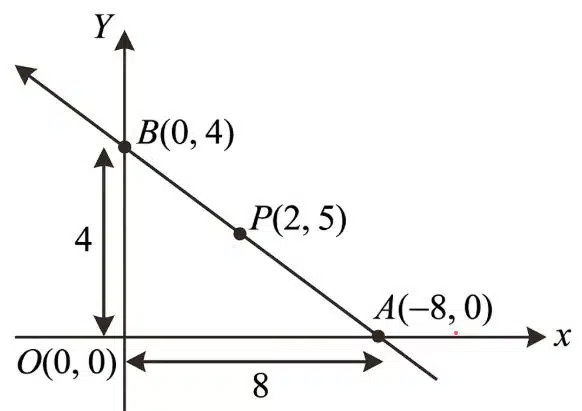
Here, gradient $m = \frac{1}{2}$ and the line passes through $(x_1, y_1) = (2, 5)$.
We know that the equation of a line passing through a point $(x_1, y_1)$ having gradient $m$ is:
$y – y_1 = m(x – x_1)$
$\implies y – 5 = \frac{1}{2}(x – 2)$
$\implies 2(y – 5) = x – 2$
$\implies 2y – 10 = x – 2$
$\implies x – 2y = -10 + 2$
$\implies x – 2y = -8$
$\implies \frac{x}{-8} – \frac{2y}{-8} = 1$ [Dividing both sides by $-8$ ]
$\implies \frac{x}{-8} + \frac{y}{4} = 1$, which is in the form $\frac{x}{a} + \frac{y}{b} = 1$.
$\therefore$ The line intersects the X-axis at $A(-8, 0)$ and the Y-axis at $B(0, 4)$.
Using the distance formula, length of line segment $AB = \sqrt{(x_2 – x_1)^2 + (y_2 – y_1)^2}$:
$AB = \sqrt{[0 – (-8)]^2 + (4 – 0)^2}$
$= \sqrt{(8)^2 + (4)^2}$
$= \sqrt{64 + 16}$
$= \sqrt{80}$
$= \sqrt{16 \times 5}$
$= 4\sqrt{5}$
$\therefore$ The length of the line segment intercepted between the coordinate axes is $4\sqrt{5}$ units.