Class 10 Science Notes Chapter 7 Control and Coordination
This article on class 10 Science Notes Chapter 7 Control and Coordination are designed to help students understand the chapter in a simple way. These notes explain all the important concepts, including the human nervous system, reflex actions, hormones, the endocrine system, and coordination in plants. These notes is written in simple language; they are ideal for quick revision and exam preparation. Whether you are studying for your school tests or the board examination, these Class 10 Science Notes Chapter 7 Control and Coordination will help you strengthen your concepts and prepare with confidence.
What Do We Mean by Control and Coordination?
Control and coordination are the essential life processes that enable living organisms control their bodily activities and accurately respond to environmental changes around them. These processes are crucial for survival, growth, and maintaining balance in their internal environment.
In animals, the nervous system and endocrine system are responsible for control and co¬ordination.
Key Terms We Must Know
Term
Simple Meaning
Stimulus
Any change inside or outside the body that an organism can sense — heat, light, sound or smell, for instance.
Response
The action taken because of a stimulus, such as pulling the hand away from a flame.
Receptor
A cell or group of cells that detects a stimulus. Example: the eye detects light.
Effector
A muscle or gland that carries out the response.
Coordination
Different body parts working together so that the body gives one smooth, correct response.
Plants have neither a nervous system nor muscles. They coordinate only through hormones and simple movements. We will look at both animal and plant coordination in this chapter.
Coordination in Animals
Nervous System in Animals
Receptors — How the Body Senses a Stimulus
Receptors are specialized tips of nerve fibers located in our sense organs that collect information from the surroundings. They are classified based on the type of stimulus they detect:
Phono-receptors (Inner Ear): The main functions are hearing and maintaining the balance of the body.
Photo-receptors (Eyes): These are responsible for visual stimulus and light.
Thermo-receptors (Skin): These receptors are responsible for pain, touch, heat, and cold stimuli.
Olfactory-receptors (Nose): These receptors receive smell.
Gustatory-receptors (Tongue): These receptors detect and differentiate tastes.
Receptor Type
Location
Detects
Phonoreceptors
Ear (inner ear)
Sound
Photoreceptors
Eye (retina)
Light
Thermoreceptors
Skin
Heat and cold
Olfactory receptors
Nose
Smell
Gustatory receptors
Tongue
Taste
The nervous system acts as the body’s primary command center. It is composed of specialized tissues made of nerve cells called neurons. The nerve cell or neuron is the functional unit of the nervous system. It is the nervous system which is mainly responsible for control and coordination in complex animals.
The Neuron — Building Block of the Nervous System
A neuron is the structural and functional unit of the nervous system. A neuron is a highly specialized cell which is responsible for the transmission of nerve impulses. It is the longest cell in the human body because its axon can grow over one meter long. A typical neuron consists of three main parts:
Cyton (Cell Body): It contains a central nucleus and cytoplasm. It processes the incoming impulses and maintains cell growth.
Dendrites: Dendrites detects the information from the environment. This information is picked up by the dendritic tips and sets off the electrical impulse which travels from dendrite to cell body and then to axon.
Axon: Axon transmits the impulse, either to another neuron or to muscles/glands, etc.
Axon can be myelinated or non-myelinated.
The impulse transmission is faster in myelinated axons.
Impulse Travel Path:
Dendrites → Cell Body (Cyton) → Axon → Axon Terminals (Telodendria) → Synapse → Next Neuron
Part
What It Does
Dendrite
Short, branched extensions that pick up signals from a receptor or from another neuron and carry them to the cell body.
Cell body (Cyton)
Contains the nucleus and cytoplasm; processes the incoming signal before it moves further.
Axon
A long fibre that carries the electrical impulse away from the cell body towards the next neuron, muscle or gland.
Myelin sheath
A fatty covering on some axons. It insulates the axon and speeds up the impulse.
Axon terminal (nerve ending)
The tip of the axon, where chemicals are released to pass the message forward.
Types of Neuron:
Depending on their job, neurons are of three kinds:
Sensory neurons: These neurons carry the message from a receptor to the brain or spinal cord.
Motor neurons: These neurons carry the message from the brain or spinal cord to an effector — a muscle or a gland.
Relay (association) neurons: These neurons sit inside the brain and spinal cord and connect sensory neurons to motor neurons. These neurons relay the signals between sensory neuron and motor neuron.
The Synapse — How a Message Crosses from One Neuron to the Next
Neurons never touch each other directly. A microscopic gap always separates the axon terminal of one neuron from the dendrite of the next. This gap is called a synapse.
Transmission of nerve impulse:
A receptor detects a stimulus and generates an electrical impulse.
The impulse travels through the dendrite, the cell body, and then along the axon.
At the nerve ending, the impulse triggers the release of chemicals called neurotransmitters.
These chemicals cross the synaptic gap and reach the dendrite of the next neuron.
A fresh electrical impulse starts in this neuron, and the message keeps moving forward until it reaches the effector.
Electrical vs Chemical Transmission
Electrical Transmission
Chemical Transmission
Electrical transmission does not require neurotransmitters
A neurotransmitter is required.
Fast mode of impulse transmission.
Comparatively slower mode of impulse transmission.
The impulse passes directly from one neuron to the next.
The impulse does not pass directly; it crosses through a chemical messenger.
Neuromuscular Junction (NMJ): When the axon terminal of a motor neuron meets a muscle fibre, the meeting point is called the neuromuscular junction (NMJ). The impulse reaching this point makes special proteins inside the muscle cell rearrange themselves, and the muscle contracts. This is how nerve impulses cause movement.
Neurotransmitters
Neurotransmitters are chemical messengers released from the axon terminals of a neuron.
They help transmit nerve impulses across the synapse.
When a nerve impulse reaches the end of a neuron, the electrical signal is converted into a chemical signal in the form of neurotransmitters.
These neurotransmitters quickly cross the synapse and carry the message to the next neuron, muscle cell, or gland cell.
After reaching the next cell, the chemical signal is converted back into an electrical impulse, allowing the nerve impulse to continue.
Types of Actions in Our Body
Actions fall into three groups:
Type
Controlled By
Conscious Thought?
Examples
Voluntary action
Brain, by our own will
Yes
Walking, writing, dancing
Involuntary action
Brain, but not by our will
No
Heartbeat, digestion
Reflex action
Mostly the spinal cord
No
Withdrawing the hand from a hot object, blinking, sneezing
Reflex Action and the Reflex Arc
What is a Reflex Action?
A reflex action is a sudden, quick, and involuntary response to an environmental stimulus that occurs without direct involvement of brain. In such a case, the spinal cord itself takes the decision, so the response is so quick. Examples include quickly pulling hand back after touching a flame.
Reflex Arc: The pathway a nerve impulse follows during a reflex action is called the reflex arc. It is the shortest route from a receptor to an effector. It is processed directly within the spinal cord to save precious time and protect the body from imminent dange.
Receptor: thermo receptors in the skin sense the heat.
Sensory neuron: carries the message to the spinal cord.
Spinal cord: processes the message at once, without waiting for the brain.
Motor neuron: carries the command from the spinal cord to the muscle.
Effector: the arm muscle contracts.
Response: the hand moves away from the cup.
The Brain’s Role in Reflex Actions:
Although reflex actions are generated instantly within the spinal cord, the sensory signal is simultaneously forwarded up to the brain. This allows the brain to process what happened, record the event, create awareness of the stimulus, and register it in our memory to prevent future dangers.
Reflex actions can also be grouped by how they are acquired:
Unconditioned reflexes: inborn and inherited — for example, sneezing and coughing.
Conditioned reflexes: learned through practice or experience — for example, riding a cycle, or the mouth watering at the smell of a favourite food.
The Human Nervous System
The human nervous system is structurally divided into three interconnected components:
Central Nervous System (CNS)
The CNS is composed of the brain and the spinal cord. It is the main control unit of the body. The brain controls all the functions in the human body. On the other hand, the spinal cord works as the relay channel for signals between the brain and the peripheral nervous system.
Peripheral Nervous System (PNS)
The peripheral nervous system is composed of the cranial nerves and spinal nerves. The cranial nerves originate from the brain and spinal nerves originate from the spinal cord. There are 12 pairs of cranial nerves and 31 pairs of spinal nerves. The cranial nerves extend to the organs in the head region. The spinal nerves extend to the organs which are below the head region.
The Human Brain — Main Control Centre
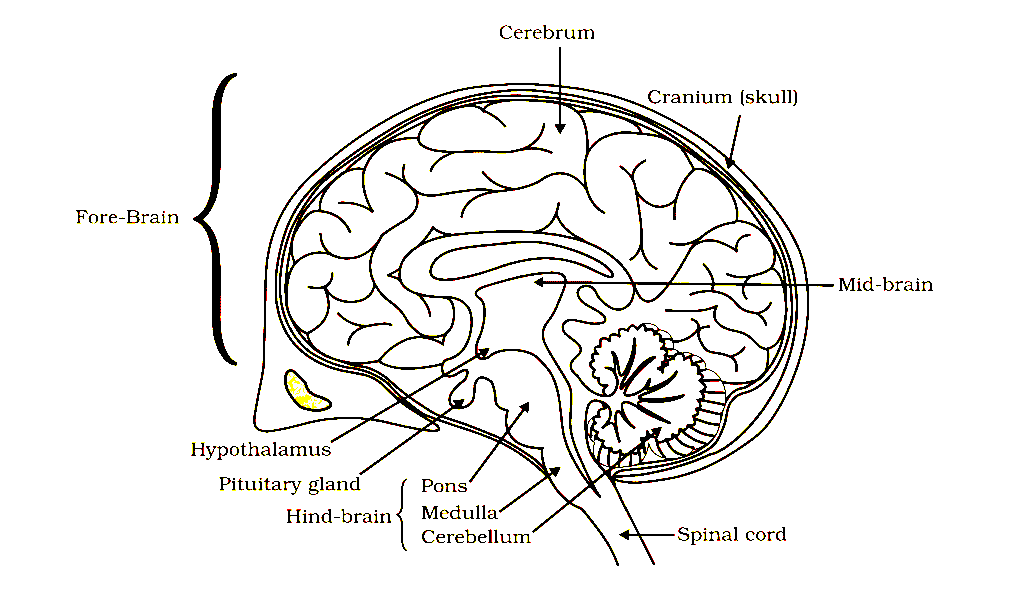
The brain is the main coordinating centre of the body. The brain has three main regions — the forebrain, the midbrain, and the hindbrain.
Forebrain
T he fore-brain is the main thinking part of the brain. Forebrain consists of cerebrum, hypothalamus and thalamus.
Cerebrum: The cerebrum is the largest part in the human brains. It is divided into two distinct hemispheres called cerebral hemispheres.
Functions of cerebrum:
The cerebrum controls voluntary actions.
It is the site of learning, reasoning, memory, intelligence, consciousness, and willpower.
It processes specific sensory perceptions like sight, hearing, and smell.
Hypothalamus: It is located at the base of the cerebrum.
Functions of Hypothalamus:
It regulates sleep, emotions, hunger, thirst, sweating, and body temperature.
It also Controls the pituitary gland.
Thalamus: It acts as a relay station, directing sensory signals to the cerebrum.
Midbrain
The midbrain is the middle part of the brain, located between the forebrain and hindbrain.
Functions of the Midbrain:
It connects forebrain and hindbrain.
It controls certain involuntary actions.
Hindbrain
Hindbrain consists of pons, medulla and cerebellum.
Cerebellum: It is the second largest part of the brain.
It is responsible for precision of voluntary actions.
It also maintains posture and balance of the body.
Pons: It acts as a neural bridge connecting the lower spinal cord and cerebellum with higher parts of the brain like the cerebrum and midbrain. It also controls breathing.
Medulla Oblongata: The medulla oblongata is the lowest part of the brainstem, connecting the brain to the spinal cord. It acts as an automatic pilot, controlling involuntary activities like heart rate,blood pressure,salivating, and vomiting.
Region
Main Parts
Key Functions
Forebrain
Cerebrum, Hypothalamus
Thinking, memory, learning, speech, emotions, and all voluntary actions (cerebrum); hunger, thirst, body temperature, and the link with the endocrine system (hypothalamus).
Midbrain
Relay centre
Connects the forebrain and hindbrain; controls certain reflex movements of the eyes and head in response to light or sound.
Hindbrain
Cerebellum, Pons, Medulla
Balance and precision of voluntary movements (cerebellum); regulates breathing and connects different brain regions (pons); controls involuntary actions such as heartbeat, blood pressure, salivation, and vomiting (medulla).
Protection of the Brain and Spinal Cord
Organ
How It Is Protected
Brain
The bony skull (cranium), three meninges, and a cushion of cerebrospinal fluid (CSF).
Spinal cord
The backbone (vertebral column), also covered by meninges and cushioned by CSF.
Protection of the Brain:
The brain is protected in a bony case known as cranium.
The brain is covered by a three-layered system of membranes, called meninges
A fluid called cerebrospinal fluid (CSF) is filled between the meninges. It acts as a shock absorber and it protects the brain from mechanical shock and injury.
Protection of the spinal cord:
The spinal cord is protected by the vertebral column (backbone).
It is also covered by meninges.
Cerebrospinal fluid (CSF) around the spinal cord provides cushioning and prevents damage.
How Nerve Impulses Bring About Muscle Movement
Muscle cells contain special proteins (like actin and myosin). When an electrical nerve impulse reaches a muscle, then these muscle cells alter both their shape and their arrangement inside the cell in direct response to nervous electrical impulses. When these proteins shift, their new arrangement gives the muscle cell a shorter form, leading to muscle contraction and movement.
The Endocrine System
Types of Glands
There are two types of glands in the human body: endocrine glands and exocrine glands.
Endocrine Glands
Endocrine glands are ductless glands.
They produce hormones, which are chemical messengers.
These hormones are released directly into the bloodstream.
The endocrine system controls and coordinates various body functions through these hormones.
Exocrine Glands
Exocrine glands have ducts to carry their secretions.
Examples include salivary glands, sweat glands, and tear glands.
Hormones:
Hormones are chemical messengers that are secreted in small quantities. They travel through the blood and act only on specific target cells or organs usually away from their source. Once a hormone has done its job, it is broken down; it is not stored for later use.
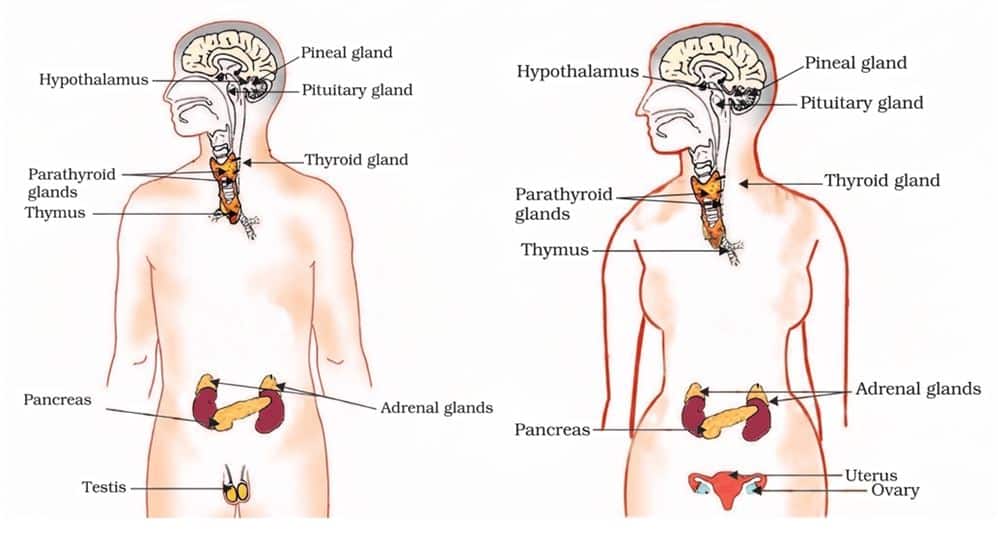
Major Endocrine Glands and Their Hormone
Endocrine Gland
Body Location
Hormones Produced
Primary Biological Functions
Associated Deficiency Disorders
Pituitary Gland(Master Gland)
Base of the brain
• Growth Hormone (GH)
• It Controls body growth
Dwarfism (due to low GH in childhood)
• Excess GH leads to gigantism.
Thyroid Gland(Largest Endocrine Gland)
Neck region below voice box
• Thyroxine
• Regulates carbohydrate, protein, and fat metabolism
• Goitre (Swollen neck caused by low iodine intake)
Adrenal Glands
Above both kidneys
• Adrenaline
• It prepares the body for emergencies (fight, flight, or fright response).
—
Pancreas(Dual Gland: Exo- and Endocrine)
Below the stomach
• Insulin
• Glucagon
Insulin lowers blood glucose; glucagon raises it.
• Diabetes Mellitus
Testes(Male)
In scrotum
Testosterone
Development of male secondary sexual characters.
—
Ovaries(Female)
Inside lower abdomen near uterus
• Oestrogen
• Progesterone
Development of female secondary sexual characters; maintains pregnancy.
—
Pineal
Melatonin
Regulates the sleep-wake cycle.
—
Parathyroid
embedded in thyroid gland
Parathormone
Regulates calcium and phosphate levels in blood and bone.
Too little causes tetany; too much causes weak, brittle bones.
Thymus
lower neck, upper chest
Thymosin
Helps in the development of immune cells (T-lymphocytes).
—
Pituitary Gland
The pituitary gland is located just below the hypothalamus (brain).
It is known as the master gland because it secretes several important hormones that control many body functions.
The hypothalamus controls the pituitary gland by releasing special hormones.
It secrets growth hormone.
If the body does not produce enough growth hormone during childhood, it causes dwarfism, in which the person has a short stature.
On the other hand, if pituitary gland produces too much growth hormone, it leads to gigantism, making the person abnormally tall.
Thyroid Gland
The thyroid gland is attached to the windpipe (trachea) in the neck.
It secretes a hormone called thyroxine.
Iodine is essential for the production of thyroxine hormones.
This hormone controls the metabolism of carbohydrates, fats, and proteins in the body.
Goitre is a condition in which the thyroid gland becomes enlarged, causing swelling in the neck.
The main cause of goitre is a lack of iodine in the diet.
Parathyroid Gland
Parathyroid glands are four small glands embedded in the thyroid gland.
These glands secrete a hormone called parathormone (PTH).
Parathormone regulates the levels of calcium and phosphate in the blood.
Thymus Gland
Thymus gland is located in the lower part of the neck and the upper part of the chest.
It secretes the thymus hormone (thymosin).
This hormone helps in the development and proper functioning of the body’s immune system.
The thymus gland is large and active during childhood.
After puberty, it gradually shrinks in size and becomes less active.
Pancreas (Dual / Mixed / Heterocrine Gland)
Pancreas is located just below the stomach.
It is a dual (mixed) or heterocrine gland, as it performs both exocrine and endocrine functions.
Exocrine Function:
It secretes pancreatic juice into the small intestine.
This juice contains digestive enzymes like trypsin and lipase.
These enzymes help in the digestion of proteins and fats.
Endocrine Function:
Pancreas secretes two hormones: insulin and glucagon.
Insulin lowers the blood sugar level.
Glucagon raises the blood sugar level when it becomes too low.
A deficiency of insulin leads to diabetes, a condition in which blood sugar level becomes high.
Adrenal Glands
The adrenal glands are a pair of glands located on top of each kidney.
They secrete a hormone called adrenaline.
Functions of Adrenaline:
It regulates heart rate, breathing rate, and blood pressure.
It is known as the “fight or flight” hormone.
Adrenal glands are also called the glands of emergency.
Testes
The testes are present only in males.
They produce the male sex hormone called testosterone.
Testosterone controls the development of male reproductive organs.
It is also responsible for the development of male secondary sexual characteristics such as a deeper voice, moustache, beard, and increased body hair.
Ovaries
The ovaries are present only in females.
They produce two important hormones: oestrogen and progesterone.
Oestrogen:
It controls the development of female reproductive organs.
It also brings about secondary sexual characteristics such as soft skin, a feminine voice, and development of mammary glands.
Progesterone:
It prepares the uterus for implantation and also helps in maintaining pregnancy.
Why Iodised Salt Matters
Iodine is essential for making thyroxine in the thyroid gland. If the diet lacks iodine, thyroxine production falls, which disturbs the metabolism of fats, carbohydrates, and proteins, and can cause goitre — a visible swelling in the neck. Using iodised salt is a simple way to prevent this deficiency.
Why Diabetes Patients Need Insulin Injections
Diabetes occurs when the pancreas stops making enough insulin, or the body cannot use the insulin it makes. Since insulin is the hormone that converts extra glucose into glycogen and keeps blood sugar under control, a shortage of insulin increase the blood glucose level. Insulin injections restore this balance and help patients manage the condition.
The Feedback Mechanism
Hormone levels in the body are regulated by a feedback mechanism — a system in which the level of one substance controls the release of another. For example, when blood sugar rises after a meal, the pancreas releases more insulin to bring it down; once the sugar level drops, insulin release slows down. This keeps hormone levels balanced and prevents overproduction or underproduction.
Coordination in Plants
Plants have neither a nervous system nor muscles, so the stimulus is not transmitted through nerves.
Instead, coordination in plants takes place through a combination of electrical and chemical signals(hormones).
When a plant receives a stimulus, the signal is first generated in one part of the plant.
This signal then passes from one cell to another.
In this way, the message is slowly transmitted across different parts of the plant.
Many plant hormones are responsible for various kinds of movements in plants..
Types of Plant Movement — Tropic and Nastic
Movements in plants can be divided into two main types :
Tropic movement
Nastic movement
Tropic Movement:
The movements of a plant part in a particular direction in relation to the stimulus are called tropic movements. Tropic movements happen as a result of growth of a plant part in a particular direction. Tropic movements are slow, growth-dependent movements. There are five types of tropic movements.
Types of Tropic Movement
A tropic movement is directional growth of a plant part towards a stimulus (positive tropism) or away from it (negative tropism).
Phototropism
The movement of a plant part in response to light is called phototropism.
When the stem grows towards light, it is called positive phototropism.
When the roots grow away from light, it is called negative phototropism.
Geotropism
The movement of a plant part in response to gravity is called Geotropism
When a plant part grows towards gravity, it is called positive geotropism. For example, roots grow downward into the soil.
When a plant part grows away from gravity, it is called negative geotropism. For example, the stem grows upward, away from the soil.
Chemotropism
The movement of a plant part in response to a chemical stimulus is called Chemotropism.
When a plant part grows towards a chemical, it is called positive chemotropism. For example, the pollen tube grows towards the ovule due to chemical signals.
When a plant part grows away from a chemical, it is called negative chemotropism.
Hydrotropism
The movement of a plant part in response to water is called Hydrotropism.
When a plant part grows towards water, it is called positive hydrotropism. For example, roots grow towards moist soil.
When a plant part grows away from water, it is called negative hydrotropism.
Thigmotropism
The growth in a plant part in response to touch or contact is called thigmotropism movement.
Such movements are seen in tendrils of climbers.
The tendril grows in a way so as it can coil around a support such as a wall, stick, or other plant.
Tendrils are sensitive to touch and show positive thigmotropism, meaning they grow towards the object they touch.
Type
Stimulus
Example
Phototropism
Light
Shoot bends towards light (positive); root grows away from light (negative).
Geotropism
Gravity
Root grows towards the ground (positive); stem grows upward, against gravity (negative).
Hydrotropism
Water
Roots bend towards a source of water.
Chemotropism
Chemicals
Growth of the pollen tube towards the ovule.
Thigmotropism
Touch/contact
Tendrils of climbing plants coil around a support.
How Does a Shoot Actually Bend Towards Light?
When light falls on a shoot from one side only, the plant hormone auxin shifts towards the shaded side. Auxin promotes cell growth, so the shaded side grows longer than the side receiving light. Because of this uneven growth, the shoot bends and turns towards the light.
A similar process happens in tendrils. When a tendril touches a support, auxin gets distributed in a way that slows down growth on the side touching the support. The opposite side keeps growing at a normal rate. This difference in growth causes the tendril to curl around the support and hold onto it.
Nastic Movement — The Sensitive Plant
The movement which do not depend on the direction from the stimulus acts are called nastic movement. In other words, the response is the same regardless of where the stimulus comes from.
For example, when the leaves of the Mimosa (touch-me-not or chhui-mui) plant are touched, they fold and droop irrespective of the direction of the touch.
These movements usually occur due to changes in the water content of plant cells. When the leaves of the Mimosa plant are touched, the cells lose water and become flaccid. As a result, the leaves fold and droop.
Tropic Movement
Nastic Movement
It depends on the direction of the stimulus.
It does not depend on the direction of the stimulus.
It is usually slow and growth-based movement.
It is usually quick and not related to growth.
It occurs due to unequal growth.
It occurs due to changes in turgor pressure inside plant cells.
More or less permanent and Irreversible
Temporary and reversible
Bending of shoot towards light (phototropism), root growth towards gravity (geotropism).
Folding of leaves of Mimosa (touch-me-not plant).
Plant Hormones (Phytohormones)
Plant hormones are chemical substances made in one part of a plant and carried to other parts, where they coordinate growth, development, and responses to the environment.
Type
Hormone
Primary Roles & Functions
Growth Promoters
Auxins
Promotes cell elongation in the shoot; controls phototropism and tendril coiling.
Gibberellins
Help in the growth of the stem.
Cytokinins
Promotes cell division; abundant in fruits and seeds.
Growth Inhibitor
Ethylene
Promotes fruit ripening and leaf fall.
Abscisic Acid (ABA)
Known as the “stress hormone”; retards plant growth. Its effects include wilting of leaves.